
Published: August 28, 2026 | thefinalconvergence.com
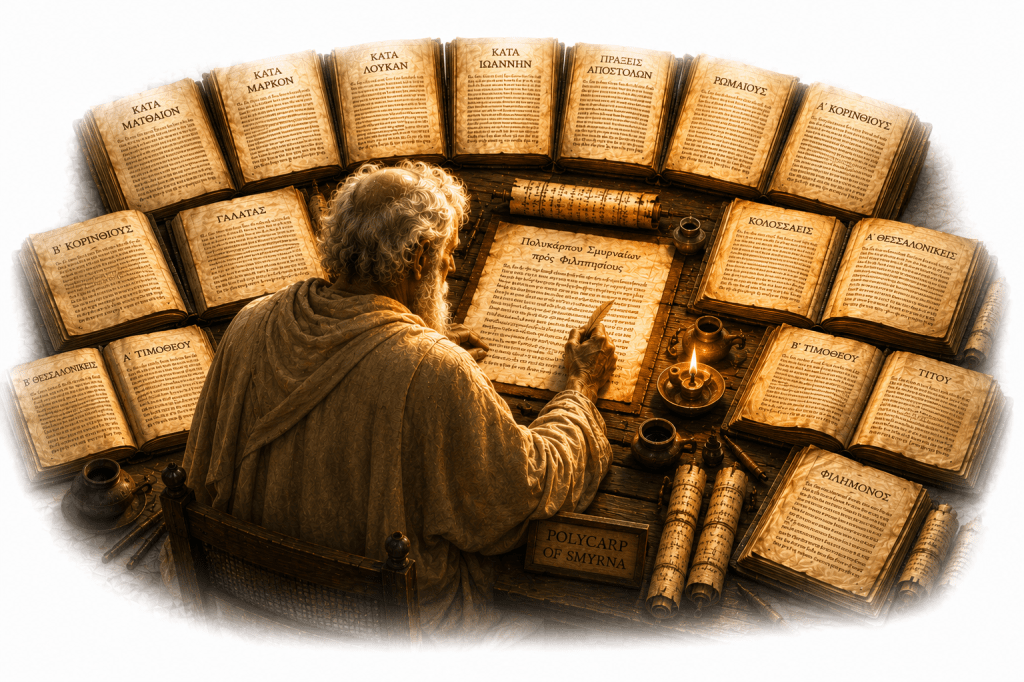
The Old Testament section closed yesterday: thirty-nine books, settled and complete, the foundation the New Testament stands on. Today the series crosses the four hundred silent years into the age of the apostles, and takes up the question the skeptics love most. Because if there is anywhere the “the Bible was assembled by political power centuries later” theory tries to make its stand, it is here, in the formation of the New Testament.
So let us watch what actually happened. Not the myth. The history.
“Heaven and earth shall pass away, but my words shall not pass away” (Matthew 24:35).
Jesus said this of His own words, the words the apostles would carry, preach, and write down. Heaven and earth will pass away. His words will not. That is a staggering claim about the permanence of what the New Testament would become. And the history of how those words moved from spoken proclamation to recognized Scripture is one of the most compelling testimonies in all of church history to the God who keeps His promises.
A New Body of Scripture, Born Fast
When Jesus ascended, He left behind eleven frightened disciples in an upper room. Within three decades, the scattered communities of believers across the Roman Empire possessed a growing body of written documents that they treated with the same reverence they had for the Hebrew Scriptures. Within a century, most of what we know as the New Testament had been written, circulated, copied, and received by the churches as the living voice of God.
The speed and coherence of this are remarkable given the conditions. There were no printing presses. No postal service for private letters. Travel was slow, dangerous, and expensive. The believing communities were scattered from Jerusalem to Rome, from Antioch to Alexandria, from Corinth to Ephesus. And yet the same core body of writings was recognized, circulated, and quoted as Scripture by believers across this vast region within decades of being written.
This does not happen by accident. It does not happen through political manipulation. It happens when the Holy Spirit who inspired the writings also works in the hearts of God’s people to recognize what He has spoken. The formation of the New Testament canon is among the most compelling testimonies to the living reality of the God who promised to preserve His Word.
The Primacy of the Gospels
At the center stand the four Gospels; Matthew, Mark, Luke, and John. They are the irreplaceable foundation, the primary sources for the life, teaching, death, and resurrection of Jesus Christ. Without them, the rest of the New Testament hangs in the air: Paul’s letters presuppose the Christ they expound, and Revelation opens with letters to churches whose faith was built on the Gospel proclamation.
And notice the apostolic anchoring of each. Matthew and John were apostles, eyewitnesses of the resurrection, called and commissioned by Jesus Himself. Mark, though not one of the Twelve, was the close associate and interpreter of Peter; the early church universally testified that his Gospel was essentially Peter’s account, written down under Peter’s oversight. Luke was the traveling companion of Paul, whose Gospel explicitly claims to be a carefully researched account based on eyewitness testimony (Luke 1:1-4), carrying Pauline apostolic authority.
The four were recognized as a defined collection very early. By around AD 170, Irenaeus of Lyon wrote that there were four and only four Gospels, using the memorable image that just as there are four regions of the world and four principal winds, so the Church has four Gospels, not more, not less. When Gnostic movements later tried to supplement or replace them with their own compositions, the church recognized those for what they were: counterfeit. The Shepherd’s voice was in the four. It was not in the imitations.
The Letters of Paul, Recognized in Real Time
After the Gospels come the thirteen letters of Paul, from the towering theological exposition of Romans to the brief personal note to Philemon, addressing the full range of Christian doctrine and practice.
And here is a fact that dismantles the “assembled centuries later” theory by itself: Paul’s letters were recognized as Scripture within the New Testament period itself. Peter, writing near the end of his life, explicitly places Paul’s letters alongside the other scriptures (2 Peter 3:15-16), a phrase that can only mean the recognized body of divinely inspired writing. And remember: Peter had publicly clashed with Paul at Antioch (Galatians 2:11-14). His recognition of Paul’s writings as Scripture was not personal loyalty or theological alliance. It was recognition of divine authority, given even about a man who had rebuked him to his face. That is the objectivity of canonical recognition.
Paul himself understood what he was writing. He commanded the Colossians to exchange his letter with Laodicea (Colossians 4:16). He charged the Thessalonians to read his letter to all the brethren (1 Thessalonians 5:27). And he stated flatly that the things that I write unto you are the commandments of the Lord (1 Corinthians 14:37). Paul did not think he was offering helpful advice. He knew he was writing Scripture, and the churches received it as such, in his own lifetime.
The Disputed Books — and Why the Disputes Prove the Integrity
The remaining letters; Hebrews, James, 1 and 2 Peter, 1, 2, and 3 John, Jude, together with Revelation complete the canon. And here honesty is required, because the canonicity of some of these was genuinely debated in the early centuries.
Hebrews, whose author is never named in the text, took longer to achieve universal recognition. James, 2 Peter, 2 and 3 John, and Jude were sometimes listed among the antilegomena, the “disputed” books. But watch carefully what that debate was and was not. It was not the church being uncertain whether it had a canon. It was the church rigorously applying its criteria, establishing apostolic connection with confidence before granting universal acceptance.
This is not a weakness in the case for the canon. It is one of the strongest evidences for its integrity. False books were being produced constantly in the early centuries. If the church had simply accepted everything that claimed apostolic authority, that would signal a careless, credulous process. Instead, the church scrutinized. It withheld universal recognition from genuinely apostolic books like Hebrews and 2 Peter until their credentials were established, while flatly rejecting the flood of Gnostic forgeries. The books that achieved recognition did so because they survived rigorous scrutiny, not because they lobbied for inclusion. A careful process that hesitates over real books and rejects false ones is exactly the process you would want guarding the canon.
Revelation — The Last Word
The book of Revelation stands in a unique position at the very end. Written by the apostle John during his exile on Patmos under Domitian (c. AD 95-96), it is almost certainly the last book of the New Testament to be written, the last word of God’s canonical revelation.
It, too, was debated in some Eastern regions. But its apostolic authorship, its profound consistency with the rest of Scripture, and its evident spiritual power ultimately secured its place. When Athanasius issued his definitive list of the twenty-seven books in AD 367, Revelation was on it.
And Revelation carries the most explicit statement in all of Scripture about the closed nature of the canon: its final warning against adding to or subtracting from the words of the book of this prophecy (Revelation 22:18-19). It is the last word of the last book written by the last apostle. The canon is closed. The covenant word is complete.
The Process: Organic, Not Political
So how did these diverse writings — different authors, different locations, roughly fifty years — come to be recognized as one unified canon? The process was organic, gradual, and Spirit-driven, and it ran along four lines.
First, the writings were read publicly in churches. Paul’s letters were read across the Pauline communities; the Gospels were read alongside the Hebrew Scriptures in worship, a practice Justin Martyr describes around AD 155. As churches were planted, copies of the apostolic writings traveled with them.
Second, the writings were copied and exchanged. The early church developed a robust culture of copying letters and gospels, requesting copies other communities held, sending them with travelers. The apostolic writings spread across the empire within decades.
Third, the writings were quoted as authoritative by church leaders. Clement of Rome, Ignatius of Antioch, Polycarp of Smyrna, the earliest post-apostolic generation, saturate their letters with New Testament quotations treated as binding Scripture. Polycarp alone quotes or alludes to seventeen of the twenty-seven New Testament books in a single short letter. He did not need a council to tell him which books were Scripture. He knew the Shepherd’s voice.
Fourth, the rise of heresy forced explicit lists. When Marcion published his drastically truncated “canon” around AD 140, a mutilated Luke and ten edited Paul letters, all Jewish content removed, the church had to articulate explicitly what it had always implicitly recognized. The Muratorian Fragment (c. AD 170-200), the oldest surviving canonical list, is exactly this kind of clarification.
By the end of the second century, the core; the four Gospels, Acts, Paul’s letters, 1 Peter, 1 John, and Revelation, was universally recognized across the Christian world. The few remaining books were being debated on specific grounds of apostolic attribution, not general content. The recognition ran centuries ahead of any council that would later formalize it.
Tomorrow, the specific criteria by which all of this recognition happened: apostolicity, consistency, and catholicity.
“Heaven and earth shall pass away, but my words shall not pass away.” — Matthew 24:35 KJV
📖 This post is adapted from Canon and Covenant: How God Preserved His Word Through History. If it helped you, the full book is available on Amazon — or you can support this ministry directly.
thefinalconvergence.com | Follow on Instagram, Facebook, X, and YouTube
If you like to be updated on new blogs, sign up to our newsletter!


Leave a Reply