
Published: August 30, 2026 | thefinalconvergence.com
Two days of the New Testament canon section have shown the writings spreading organically from scrolls to Scripture and the criteria by which the church recognized them. Which brings us to the councils, and to the single most persistent misconception about the Bible in popular culture.
The idea goes like this: before the Council of Nicaea in AD 325, or the Council of Carthage in AD 397, nobody really knew what was in the Bible. The canon was determined by political maneuvering, power struggles, and the suppression of alternative traditions. Constantine assembled it. The councils voted. The losers were censored.
It is repeated so often that many assume it is historical fact. It is not. It is historical fiction masquerading as historical scholarship, and today we set the record straight.
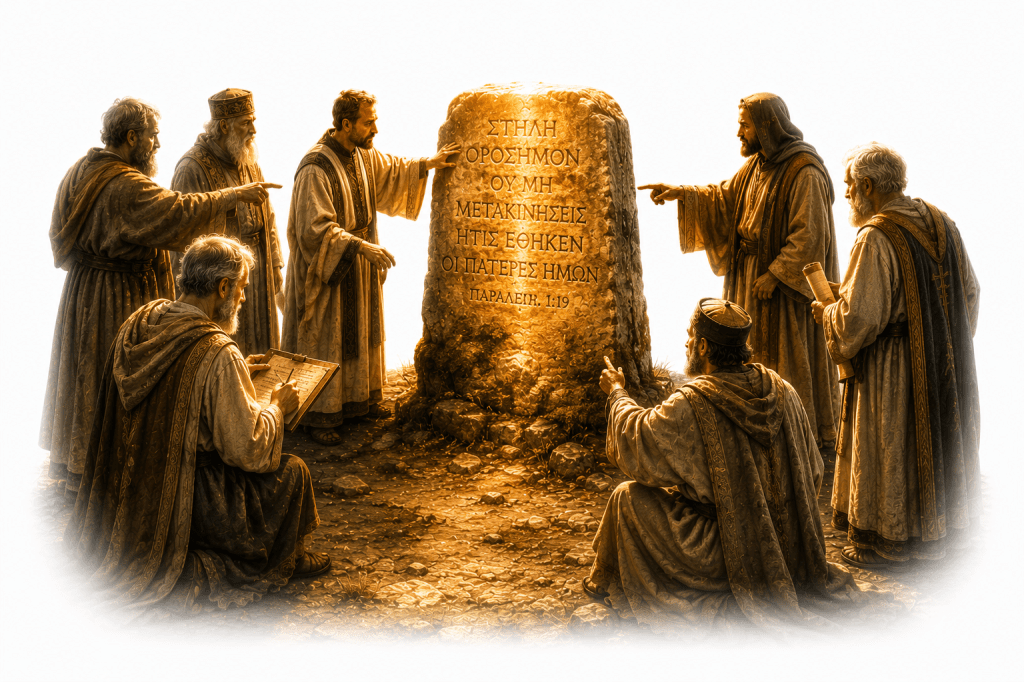
“Remove not the ancient landmark, which thy fathers have set” (Proverbs 22:28).
An ancient landmark is a boundary stone, set long ago, marking a border everyone already recognizes. You do not create a landmark by pointing at it. It was there before you arrived. That is exactly what the councils did with the canon. They did not build the boundary. They pointed to the ancient landmark the church had recognized for generations, and said: this is where the line has always been.
Councils Affirm — They Do Not Create
The truth is that the church councils of the fourth century did not create the biblical canon. They acknowledged it.
By the time the Council of Nicaea convened in AD 325, the twenty-seven books of the New Testament had been read, copied, quoted, and treated as Scripture in churches across the Roman world for over two centuries. The four Gospels, Acts, Paul’s letters, 1 Peter, 1 John, and Revelation were no more in question at Nicaea than the multiplication tables are in question at a mathematics conference. The councils, particularly Hippo in AD 393 and Carthage in AD 397, provided public, authoritative affirmation of what the Spirit-led church had already recognized. They drew a line in the sand, not because the content of the canon was uncertain, but because the proliferation of heretical writings and the needs of the wider church required a clear public statement.
This is the recognition principle applied to the councils themselves. A council that recognizes the canon can affirm, clarify, and defend it. Only a council that believes it creates the canon could invent it. And the historical record shows affirmation, not invention.
What Nicaea Actually Did
Almost nothing about the Council of Nicaea in popular mythology is accurate.
Dan Brown’s The Da Vinci Code famously claimed that Constantine invented the divinity of Jesus at Nicaea by a “close vote.” This is false on every count. The divine nature of the Son of God had been a matter of heated dispute in the church long before Nicaea was ever convened. The council was called specifically to address the teaching of Arius of Alexandria, a presbyter who argued that the Son of God was a created being with a beginning in time, subordinate to the Father not merely in role but in His very nature and essence. Nicaea met to settle that dispute. It did not meet to settle the canon.
And this is the point that matters most here: the Council of Nicaea did not produce a canon list. It did not address which books belonged in the Bible. This is simply not in the historical record of the council’s proceedings. The legend that Constantine assembled the Bible, or imposed it on the church by suppressing competing Gospels, is a modern fabrication with no basis in primary historical sources.
Nicaea addressed the Arian controversy and, separately, the date on which the resurrection would be commemorated across the empire. Both questions deserve careful examination on their own terms. But neither is the canon. Nicaea was not a canon council. The canon was not on the agenda, because the core of the canon was not in question. The church had already recognized it.
The Second-Century Witness
To see how far the recognition ran ahead of any council, look at the second century.
The Muratorian Fragment, discovered by the Italian librarian Lodovico Muratori in the eighteenth century and dated to approximately AD 170-200, is the oldest surviving canonical list. It lists twenty-two of the twenty-seven New Testament books, including the four Gospels, Acts, Paul’s letters, Jude, two letters of John, and Revelation. And it explicitly rejects the Shepherd of Hermas, a popular devotional writing of the period, from the canon, on the ground that it was written quite recently, in our own times.
The significance is hard to overstate. By the end of the second century, over a hundred years before Nicaea, the church already had a clear, articulate understanding of the New Testament canon that closely matches what the councils later affirmed. The councils were not creating something new. They were documenting something old. And notice the reasoning the Fragment uses to reject Hermas: it was too recent to be apostolic. The early church was already applying the criteria of Day 12, already guarding the boundary, already treating the canon as a defined and ancient landmark.
Athanasius and the First Complete List
The first complete list of all twenty-seven New Testament books in exactly their final canonical form appears in the 39th Festal Letter of AD 367, written by Athanasius of Alexandria, a bishop who spent much of his life in exile for refusing to bend his convictions to imperial and ecclesiastical pressure.
In that letter, Athanasius listed the Old and New Testament books for the churches under his care, with the explicit purpose of distinguishing the canonical Scriptures from the apocryphal writings that heretics were circulating under false apostolic attributions. He named our twenty-seven New Testament books and affirmed them as the fountains of salvation, in which alone is proclaimed the doctrine of godliness. Let no one add to these; let nothing be taken away.
The language is precise, authoritative, and grounded in the same biblical principle that underlies the whole doctrine of the closed canon. And the list was not Athanasius’s invention. He was codifying what the churches had practiced for generations. But his formulation, from one of the most respected theological voices in the Eastern church, carried enormous weight and helped settle any remaining questions.
Hippo, Carthage, and a United Testimony
The Council of Hippo, meeting in North Africa in AD 393, formally affirmed the sixty-six-book canon, the same thirty-nine Old Testament and twenty-seven New Testament books we have today. Its decisions were confirmed four years later by the Council of Carthage in AD 397, whose proceedings are better preserved. Carthage declared that besides the canonical scriptures, nothing is to be read in church under the name of divine Scripture. This was not creating a new authority for the books. It was protecting the churches from the flood of spurious writings still circulating in some communities, giving pastors a definitive reference point for rejecting counterfeit scripture.
And a crucial detail is often missed: these were regional North African councils, not ecumenical worldwide councils. Their decisions were not imposed on the universal church by imperial authority. They reflected what the vast majority of the church already believed and practiced. Their authority derived from their faithfulness to the apostolic tradition, not from institutional power.
The most striking testimony of all is the convergence of East and West. The Greek-speaking Eastern churches and the Latin-speaking Western churches were separated by language, culture, liturgy, and theological emphasis. Yet they arrived at essentially the same canonical conclusion, independently. Minor regional variations lingered at the margins (some Eastern churches slower on Revelation; some Western consideration of the Shepherd of Hermas), but these concerned peripheral writings, never the core. When the councils formally addressed the question, they produced lists that were virtually identical.
This convergence across geographical, linguistic, and cultural lines is exactly what you would expect if the canon was being recognized under the guidance of a single Spirit who had inspired the writings in the first place. It is not what you would expect if the canon were the product of political imposition. Political impositions do not spontaneously agree across rival cultures. The Shepherd’s sheep, scattered across the whole world, heard the same voice, and named the same books.
The Line Was Always There
Put it together and the popular myth collapses entirely. Nicaea did not decide the canon. Constantine did not assemble the Bible. No council voted the losers into oblivion. The Muratorian Fragment shows the canon recognized a century before Nicaea. Athanasius codified in 367 what the churches had practiced for generations. Hippo and Carthage, regional, not imperial, affirmed what the vast majority already held. And East and West, divided in everything else, converged on the same twenty-seven books.
The councils removed no landmark and set no new one. They pointed to the ancient boundary the fathers had recognized all along, and declared to a church beset by forgeries: this is where the line has always been.
Tomorrow, what that closing of the canon means, and why no council, no pope, and no modern apostle can move the line.
“Remove not the ancient landmark, which thy fathers have set.” — Proverbs 22:28 KJV
📖 This post is adapted from Canon and Covenant: How God Preserved His Word Through History. If it helped you, the full book is available on Amazon — or you can support this ministry directly.
thefinalconvergence.com | Follow on Instagram, Facebook, X, and YouTube
If you like to be updated on new blogs, sign up to our newsletter!


Leave a Reply