
Published: August 31, 2026 | thefinalconvergence.com
Yesterday the myth collapsed: the councils affirmed the canon, they did not create it. The line was always there. But that raises the question this whole section has been driving toward, the question that separates the Reformation from Rome, and the biblical church from every movement that would reopen the Book.
If the councils only recognized the canon, who closed it? And can anyone open it again?
There are two answers on offer, and everything hangs on which one is true. One says a human institution has ongoing authority over Scripture, authority to interpret it, supplement it, and add to it. The other says God closed the canon Himself when He finished speaking, and no human authority can move the line He drew.
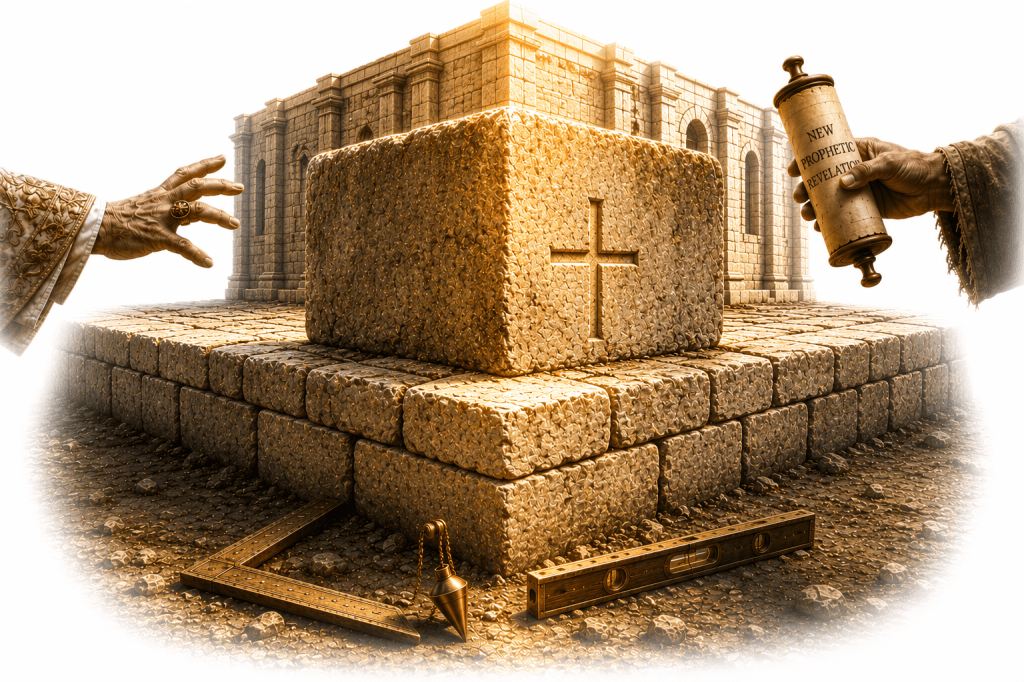
“And are built upon the foundation of the apostles and prophets, Jesus Christ himself being the chief corner stone” (Ephesians 2:20).
A foundation is laid once. You do not pour it again in every generation. The church is built upon the foundation of the apostles and prophets, with Christ Himself as the cornerstone, which means the apostolic foundation is a finished, historical, unrepeatable thing. The foundation has been laid. The canon that records it is closed. And no council, no pope, and no modern apostle can add a single brick to a foundation God has already finished pouring.
Rome’s Error — The Church as Creator of Scripture
To see why the canon is closed, you have to see clearly the position that says it is not. And the most developed version of that position is Rome’s.
Roman Catholic theology has historically claimed that the church is the source of Scripture’s authority, that Scripture derives its authority from the church’s recognition of it, rather than possessing inherent divine authority that the church simply acknowledges. The Vatican II document Dei Verbum (1965), while more nuanced than earlier formulations, still maintains a fundamental parity between Scripture and Tradition as two channels of divine revelation, both interpreted authoritatively by the church’s Magisterium.
This is the exact inversion the whole series has been tracing, recognition turned into creation, the servant made the master. And it is not a difference of emphasis. It has profound, concrete consequences.
If the church is the source of Scripture’s authority, then the church can also add to Scripture. And Rome has done precisely this, again and again. It added the Apocrypha at Trent. It adds through papal pronouncements declared ex cathedra. It adds through the Marian dogmas, the Immaculate Conception (1854) and the Bodily Assumption (1950), neither of which is found in the sixty-six books. It adds through the doctrine of papal infallibility (1870) and the tradition of purgatory. In this system the pope becomes, in effect, a continuing canonical authority, a living voice that can bind the conscience with new doctrine the Scriptures never taught. And a canon with a living voice still adding to it is a canon that is never truly closed.
This is the practical payoff of the recognition-versus-creation question. Get it wrong, and the Book is never finished. There is always another dogma, another pronouncement, another tradition that must be received with the same submission as Scripture. Get it right, and the Book is complete, and every later addition, however ancient or venerable, stands exposed as an addition.
The Church Was Created by the Word
The decisive answer to Rome is not merely historical. It is theological, and it runs to the very nature of the church.
So then faith cometh by hearing, and hearing by the word of God (Romans 10:17).
The church did not produce the Word. The Word produced the church. Faith comes by hearing the Word of God, which means there was a Word before there was a believing church to hear it. The gospel that the apostles preached created the communities that became the church. The Word is logically and historically prior to the institution. And a thing that was created by the Word cannot stand in authority over the Word. The stream does not command the spring. The building does not instruct the foundation.
This is why the Roman position is a fundamental inversion. The church was created by the Word, and therefore stands under the Word, not above it. The apostles were commissioned by Christ, not by an institution, they wrote Scripture because Christ commanded it through the Spirit, not because a council authorized it. The institution did not license the apostles; the apostolic Word gave birth to the institution. Rome has the order of authority exactly backwards, and the whole edifice of ongoing canonical authority is built on that reversal.
Why the Canon Is Closed — God Finished Speaking
So who closed the canon? Not a council. Not Athanasius. Not Carthage. God did, when He finished speaking through His apostles.
This is the heart of it. The canon is closed because the apostolic office is closed, and the apostolic office is closed because its foundation-laying work is finished. The apostles were the eyewitnesses of the risen Christ, directly commissioned by Him, promised the Spirit would guide them into all truth (John 16:13). Their writings are the foundation of the church (Ephesians 2:20). And a foundation, by its nature, is laid once. When the last apostle died, John, at the end of the first century, the foundation was complete. There was no more foundation to lay, and therefore no more canonical Scripture to write.
The councils did not close the canon by decree. They recognized a canon that God had already closed by finishing His revelation. Athanasius’s let no one add, let nothing be taken away was not the church locking a door of its own making. It was the church acknowledging a door God had already shut. The canon is closed because God stopped speaking canonically when the apostolic foundation was complete, and no human authority can reopen what God has closed.
This is the answer to every movement that would add to the Book. Rome adds dogmas and calls it Tradition. The NAR adds prophetic words and calls it fresh revelation. The cults add new scriptures and call them completion. But every one of them is trying to pour foundation onto a foundation that was finished two thousand years ago. The cornerstone is set. The apostles and prophets are laid. The structure rises on that foundation, it does not extend it.
The Line No One Can Move
Put the whole New Testament section together and the picture is complete and secure.
The writings spread organically from scrolls to Scripture, recognized across the empire within decades (Day 11). The church recognized them by clear criteria that identified authority rather than granting it (Day 12). The councils affirmed the ancient landmark rather than inventing it (Day 13). And the canon stands closed, not by a council’s decree, but by God’s own act of finishing His revelation through the apostolic foundation He laid once and for all.
That is why the line cannot be moved. It was not drawn by human hands, so it cannot be redrawn by human hands. Rome cannot move it with a papal pronouncement. The NAR cannot move it with a prophetic word. The progressive cannot move it by declaring the apostles culturally conditioned. The line was set by God when the foundation was laid, and it will stand until heaven and earth pass away.
Tomorrow the New Testament section closes, the whole canon settled, sixty-six books, complete and closed, and what that means for the church that stands on it.
“And are built upon the foundation of the apostles and prophets, Jesus Christ himself being the chief corner stone.” — Ephesians 2:20 KJV
📖 This post is adapted from Canon and Covenant: How God Preserved His Word Through History. If it helped you, the full book is available on Amazon — or you can support this ministry directly.
thefinalconvergence.com | Follow on Instagram, Facebook, X, and YouTube
If you like to be updated on new blogs, sign up to our newsletter!


Leave a Reply