
Published: September 3, 2026 | thefinalconvergence.com
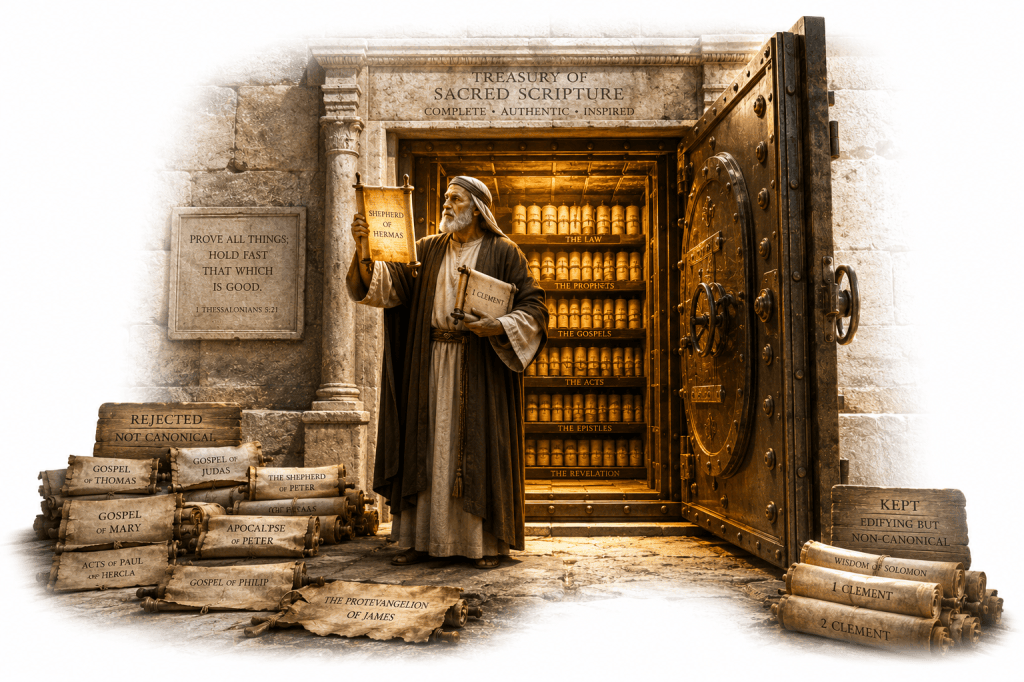
Yesterday exposed the Gnostic gospels, counterfeits that imitated the form of Scripture while gutting its content. But there is a broader category of writing that troubles sincere believers even more, because it does not look like obvious heresy. It looks like it might belong.
These are the pseudepigrapha, writings falsely attributed to biblical figures, and the endless modern claims about the lost books of the Bible, the texts that were supposedly cut, hidden, or suppressed. And here a careful believer needs a tool: the ability to read a book, even value a book, even quote a book, without treating it as Scripture.
“Prove all things; hold fast that which is good” (1 Thessalonians 5:21).
Prove all things. Test them. And then, hold fast to that which is good. Notice the two movements. You do not have to burn every book that is not in the canon. You test it, you keep what is good in it, and you refuse to confuse it with the Word of God. That is exactly the posture the church has always taken toward the pseudepigrapha: read with discernment, valued where valuable, but never mistaken for the sixty-six.
False Names, False Claims
The word pseudepigrapha means, literally, “false writings,” or more precisely, writings under a false name. Some predate Christianity; others were produced by Jewish or Christian communities in the early centuries AD. Their common thread is that they attempt to claim authority by false attribution, putting the name of a great biblical figure at the top of a book that figure did not write.
This is itself a violation of the honesty that marks genuine Scripture. The canonical books do not need to borrow a famous name; their authority is intrinsic. But a writing that must attach itself to Enoch, or Moses, or Peter, or Thomas to be taken seriously is announcing its own weakness. If the content carried divine authority, it would not need a stolen signature.
1 Enoch — The Jude Question
The most theologically influential of the pseudepigraphal texts is 1 Enoch, a collection of visions, heavenly journeys, and cosmological speculation falsely attributed to the pre-Flood patriarch Enoch. It was enormously popular in some sectors of Second Temple Judaism, and it left fingerprints on the imagery of several New Testament texts.
And here is where sincere believers get genuinely puzzled, because Jude quotes it. Jude 14-15 cites 1 Enoch 1:9, Behold, the Lord cometh with ten thousands of his saints, to execute judgment upon all. This has led some to conclude that Jude regarded 1 Enoch as inspired Scripture, and therefore that the book belongs in the canon, or at least that the canon is fuzzier than we have claimed.
That conclusion is a mistake, and correcting it teaches a principle worth keeping. New Testament authors occasionally quote non-canonical texts. Paul quotes the pagan Cretan poet Epimenides in Titus 1:12 (the Cretians are alway liars) and the Greek poet Aratus in Acts 17:28 (for we are also his offspring). No one concludes from this that the poetry of Epimenides and Aratus is inspired Scripture. Quoting a text means you regard a particular statement in it as true or relevant. It does not mean you endorse the whole work as the Word of God.
This is prove all things; hold fast that which is good in action. Jude reached into 1 Enoch, held fast to the one true statement he found there about the Lord’s coming in judgment, and used it, without thereby canonizing the visions, the fallen-angel elaborations, and the cosmological speculation that fill the rest of the book. Quotation is not endorsement. A true sentence can appear in a book that is not Scripture, just as a true sentence can appear in a sermon, a hymn, or a pagan poem. The presence of the quotation tells us Jude found that line true; it tells us nothing about the canonicity of the book he found it in. And notably, 1 Enoch itself fails the criteria at every turn, its Enochian authorship is impossible, its content is inconsistent with the rest of Scripture, and it was never received as canonical by either the Jewish community or the church.
The Shepherd of Hermas — Earnest but Not Inspired
A second instructive case is the Shepherd of Hermas, a second-century Roman Christian writing of visions, mandates, and parables. This one is not a Gnostic counterfeit or a cynical forgery. It is a genuinely earnest, morally serious text, and it was popular enough in the early church to be bound into some manuscripts, including the famous Codex Sinaiticus, and to appear on the edges of some early canonical discussions.
So why is it not in the canon? For exactly the reasons the criteria supply. The Muratorian Fragment, that second-century canon list from Day 13, explicitly excludes it, on the ground that it was written quite recently, not by an apostle. Origen valued it as edifying but did not treat it as canonical Scripture. Its popularity is understandable; earnest and edifying writing has real value. But earnestness does not equal inspiration.
This is a vital distinction, and it protects the believer from a common confusion. A book can be sincere, morally serious, spiritually helpful, and widely loved, and still not be Scripture. The test of canonicity was never is this book edifying? Plenty of non-canonical books are edifying: Pilgrim’s Progress, Augustine’s Confessions, the works of the Reformers, countless faithful sermons. The test was is this the God-breathed, apostolic Word? The Shepherd of Hermas was edifying. It was not apostolic. And the early church, applying its criteria honestly, kept the two categories distinct, reading it for profit while refusing to read it as Scripture.
The “Lost Books” Myth
All of this feeds a persistent modern myth, the claim that there are lost books of the Bible, texts that were cut, censored, or suppressed, and that the Bible you hold is a truncated, politically edited version of some richer original.
The myth sells documentaries and books, but it collapses on contact with the actual history. The pseudepigrapha and the Gnostic writings were not lost books of the Bible. They were never in the Bible to be lost. They were writings that existed alongside the Scriptures and were evaluated by the church against its criteria, and found wanting. To call them lost books of the Bible is like calling counterfeit bills lost currency from the treasury. They were never issued by the treasury. They were manufactured elsewhere and rejected at the counter.
And notice the pattern from the whole rejected-writings section. The Gnostic gospels were recognized and refuted, some within a generation. The pseudepigrapha were evaluated and set outside. The Shepherd of Hermas was valued and yet excluded. In every case the church did exactly what 1 Thessalonians 5:21 commands, it proved all things and held fast to that which is good, keeping the genuine Word and refusing the counterfeit and the merely-edifying alike. There was no great suppression. There was careful, honest, Spirit-led discernment, exactly as you would want from the custodians of the covenant.
The “lost books” were never lost. They were weighed, and they were found wanting. The canon did not shrink from something larger. It stands complete at sixty-six, exactly as it was recognized, and everything outside it is either counterfeit, or edifying-but-not-inspired, and the church has always known how to tell the difference.
Tomorrow, the biggest modern myth of all, the one that ties this whole section together: Constantine chose the canon, and the other conspiracy theories answered head-on.
“Prove all things; hold fast that which is good.” — 1 Thessalonians 5:21 KJV
📖 This post is adapted from Canon and Covenant: How God Preserved His Word Through History. If it helped you, the full book is available on Amazon — or you can support this ministry directly.
thefinalconvergence.com | Follow on Instagram, Facebook, X, and YouTube
If you like to be updated on new blogs, sign up to our newsletter!


Leave a Reply