
Published: September 6, 2026 | thefinalconvergence.com
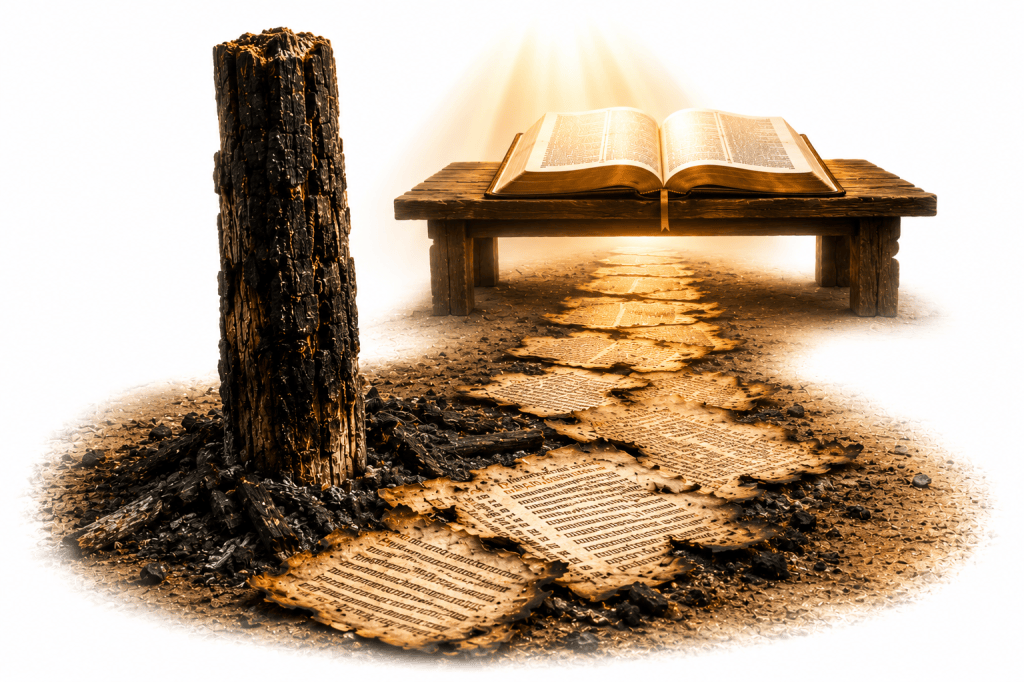
The series has established the canon: sixty-six books, recognized and closed, defended against every counterfeit. But recognizing which books belong is one thing. Getting those books, in the original languages, faithfully into the hands of ordinary people in their own tongue is another. And no single volume in the history of the English-speaking world embodies that second story like the King James Bible of 1611.
Today we look at the KJV specifically in relation to the canon, how it came to embody the sixty-six-book Protestant canon, and what its history reveals about the Providence that has guarded God’s Word.
“But the word of the Lord endureth for ever. And this is the word which by the gospel is preached unto you” (1 Peter 1:25).
The word of the Lord endureth for ever. The men who gave us the English Bible believed that with their lives, and some of them gave their lives for it. They believed a Word built to endure forever deserved to be carried, at any cost, into the hands of every plowman and every child. The KJV is a monument to that conviction: the enduring Word, faithfully preserved, placed in the common tongue.
The Fruit of the Reformation — and of Martyrs
The King James Bible did not emerge from a vacuum. It was the fruit of the Protestant Reformation, and without the Reformation it would not exist.
For centuries Rome had maintained that the Latin Vulgate was the authoritative Bible of the Western church, and that translating Scripture into the vernacular, the common language of ordinary people, was dangerous and subversive. The official position was that the Bible required authoritative interpretation by the Magisterium, and that putting it into the hands of ordinary readers without clerical mediation was an invitation to heresy. In other words: the Book belonged to the institution, not to the people.
William Tyndale challenged that at the cost of his life. Trained at Oxford and Cambridge, convinced that the English plowman deserved to know Scripture as well as the pope, he spent years in exile producing the first printed English New Testament in 1526 and significant portions of the Old Testament, before he was captured, strangled, and burned at the stake in 1536 near Brussels. His dying prayer was Lord, open the King of England’s eyes. It was answered within three years, when Henry VIII authorized the Great Bible of 1539, built substantially on Tyndale’s own work.
The line ran on: the Geneva Bible of 1560, produced by English exiles under the influence of Calvin and Beza, the Bible Shakespeare knew, the Bible the Pilgrims carried to Plymouth, the Bible that shaped a generation of Puritan theology. It was the immediate predecessor of the KJV and the translation on which the King James scholars built most directly. When the forty-seven scholars completed their work in 1611, it was not so much a new translation as the culmination of a century of English Protestant labor, the fruit of martyrs, scholars, and reformers who believed the Word of God is the inheritance of all who belong to Him, not the property of an institutional elite. Every believer today who opens a Bible in their own language owes something to the men who paid dearly to make it possible.
The KJV and the Sixty-Six-Book Canon
For the purposes of this series, the single most important fact about the King James Bible is not its literary beauty or even its textual foundation. It is this: the KJV translates the sixty-six books of the Protestant canon, the same thirty-nine Old Testament books confirmed by Jesus and the apostles, and the same twenty-seven New Testament books recognized by the early church. It does not include the Apocrypha as Scripture.
The original 1611 edition did include the apocryphal books, but in a clearly separated section between the Testaments, explicitly designated as not canonical. The translators’ preface carefully explained that these books were included for historical and devotional interest, not as inspired Scripture. Over the next two centuries, as Protestant conviction on this point sharpened, particularly among the Puritans shaped by the Geneva tradition, the Apocrypha was gradually dropped from printed editions. By the early nineteenth century most KJV editions omitted it entirely, and that has been the standard ever since.
That trajectory confirms the principle that has governed the canon throughout its history: the sixty-six-book canon is the product of careful, Spirit-guided recognition, and the Apocrypha has never genuinely belonged to it. The Reformation recovered the clarity, the KJV embodied it, and the ongoing Protestant tradition has maintained it.
The Textual Foundation — Masoretic Text and Textus Receptus
The King James Bible was translated from the best available manuscripts in the original languages: the Hebrew Masoretic Text for the Old Testament and the Greek Textus Receptus for the New Testament.
The Masoretic Text is the culmination of the Jewish scribal tradition, the work of the Masoretes who labored from roughly the sixth to the tenth centuries to standardize and protect the Hebrew text. As the earlier chapters showed, the Dead Sea Scrolls confirmed that this text had been preserved with extraordinary fidelity across a thousand years of copying. The KJV translators worked from the best Masoretic manuscripts available in the early seventeenth century, with a care and reverence that was itself a form of worship.
For the New Testament, the KJV rests on the Textus Receptus, the received text compiled by Erasmus beginning in 1516 and refined by later editors including Stephanus and Beza. The Textus Receptus draws primarily on the Byzantine, or Majority, Text, the family representing the overwhelming majority of surviving Greek New Testament manuscripts. (Modern textual scholarship has also produced critical texts, the Nestle-Aland and UBS editions, based on a smaller number of earlier manuscripts from different families, and these underlie most modern translations.)
Now, a word of honesty and restraint. The question of which manuscript tradition best preserves the original text is a genuine and important one, and faithful, learned, Scripture-loving believers have held different positions on it for well over a century. That debate deserves its own careful, thorough treatment, and it is coming, in a dedicated volume. It is not this book, and it is not this chapter. What can be said here with full confidence is this: God has not left His people without His Word. More than 5,800 Greek manuscripts of the New Testament survive; the degree of agreement among them is remarkable; and no core doctrine of the Christian faith rests on a disputed reading. The breadth and depth of the manuscript tradition is itself a testimony to the Providence that has guarded the text of Scripture across twenty centuries.
Two Distinct Questions — Canon and Translation
As this chapter closes, one distinction must be held clearly, because it is constantly conflated and must not be.
The canon question asks: which books belong in the Bible? That is the question this entire series has addressed, and its answer is settled, sixty-six books, recognized by the faithful across the centuries, confirmed by Christ, preserved by Providence, sufficient until the Lord returns. On this question there is no meaningful dispute among Protestant believers. Whether you read the KJV, the NASB, the ESV, or any other faithful Protestant translation, you are reading the same sixty-six books. The canon is not a translation issue.
The translation question asks: which text, and which English rendering, best conveys what those sixty-six books originally said? This is where faithful believers disagree, sometimes sharply, and where the manuscript debate, the translation-philosophy debate, and the question of formal versus dynamic equivalence all come into play. This book is not the place to adjudicate those questions. They require their own careful, historically grounded treatment.
Holding those two questions apart is itself an act of clarity. Canon first, and settled. Translation second, and genuinely debated. Confusing them produces endless heat and little light. Keeping them distinct lets us honor the KJV for what it unquestionably is, without prejudging a debate that deserves its own full hearing.
A Monument in the Story of the Canon
So here is what the King James Bible is, in relation to everything this series has been building. It embodied the sixty-six-book Protestant canon at a moment when that canon was under direct attack from Rome. It carried the fruit of the Reformers’ suffering, Tyndale’s above all, into the hands of ordinary people in their own language. It excluded the Apocrypha not by accident but by theological conviction. And it has proven, over four centuries, to be a translation of extraordinary beauty, durability, and spiritual power, whose cadences shaped the English language itself and whose words went with believers to the ends of the earth.
Whatever position a believer ultimately holds on the translation question, the story of how the KJV came to exist is inseparable from the story of how the canon came to be recognized, defended, and preserved. It is a monument to the same truth that has run through every day of this series: the canon of Scripture is not a human achievement but a divine gift, inspired, preserved, recognized, and now entrusted to every believer who will receive it with the seriousness it demands.
And that raises the very question the next chapter takes up, the question that follows once the right books are settled: within those books, which words? Tomorrow, from canon to text.
“But the word of the Lord endureth for ever.” — 1 Peter 1:25 KJV
📖 This post is adapted from Canon and Covenant: How God Preserved His Word Through History. If it helped you, the full book is available on Amazon — or you can support this ministry directly.
thefinalconvergence.com | Follow on Instagram, Facebook, X, and YouTube
If you like to be updated on new blogs, sign up to our newsletter!


Leave a Reply