
Published: September 9, 2026 | thefinalconvergence.com
Yesterday’s post named the end-time deception in general terms, the counterfeit gospel sustained by counterfeit scripture. Today we name a specific movement, because it is the one that most directly reopens the canon in our own generation, and it may be the fastest-growing and most theologically dangerous religious movement in the world today.
The New Apostolic Reformation. And its central problem, from the standpoint of everything this series has established, is simple to state: it is a movement that cannot coexist with a closed canon.
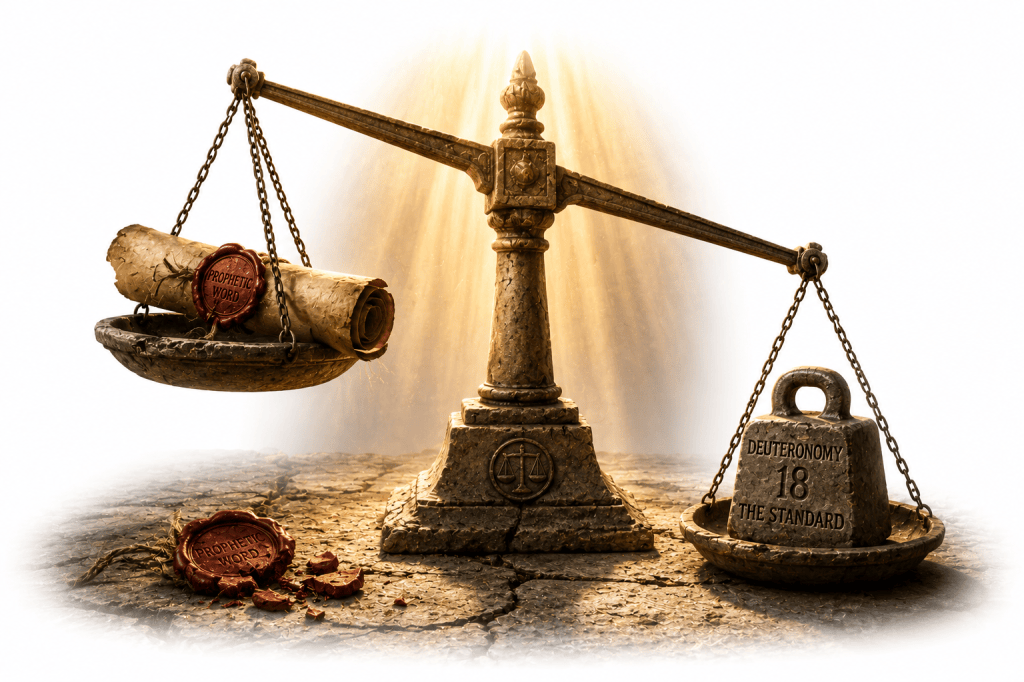
“When a prophet speaketh in the name of the LORD, if the thing follow not, nor come to pass, that is the thing which the LORD hath not spoken, but the prophet hath spoken it presumptuously: thou shalt not be afraid of him” (Deuteronomy 18:22).
God gave His people a test for anyone who claims to speak for Him, and it is ruthlessly objective. Did the word come to pass? If not, the LORD did not speak it, and you need not fear the one who claimed it. This single verse, applied consistently, dismantles the entire prophetic apparatus of the NAR. Which is precisely why the NAR never applies it.
A Movement That Cannot Coexist with a Closed Canon
The term New Apostolic Reformation was coined by C. Peter Wagner of Fuller Theological Seminary to describe a movement he claimed was restoring the New Testament offices of apostle and prophet to the church. It is not a single organization with a single leadership. It is a network, a movement of movements, connected by shared convictions, relational ties, shared events, and a shared vocabulary. Its influence now reaches thousands of affiliated churches on every continent.
The theological core is the claim that matters most for this series: that God has restored the fivefold offices of Ephesians 4:11; apostles, prophets, evangelists, pastors, teachers, to the church in their full New Testament authority. The emphasis falls on apostles and prophets. In the NAR framework, apostles govern God’s kingdom on earth through organizational authority and strategic direction, while prophets provide the living word of God for the church’s mission.
The implication for the canon is immediate and unavoidable. If modern apostles carry the same divine authority as the New Testament apostles, if God speaks through them with the same binding force with which He spoke through Paul or John, then the canon is functionally not closed. It continues to be written. And the test of a true Christian shifts from do you believe what is written? to do you submit to the apostle’s authority? This is not a small adjustment. It is a different religion wearing the same vocabulary.
Recall Day 4 and Day 14. The apostolic office was unique and unrepeatable, eyewitnesses of the risen Christ, directly commissioned, the foundation laid once (Ephesians 2:20). To claim restored apostolic authority is to claim the right to reopen a canon God Himself closed. The NAR’s foundational claim collides directly with the foundational fact of the canon.
The Prophetic Culture and Its Consequences
The NAR’s most visible feature is its prophetic culture. Prophetic ministry here means something specific: anointed individuals who regularly receive direct words from God, which they deliver to individuals, churches, cities, nations, and even the whole Body of Christ. These are not presented as impressions or applications of Scripture. They are claimed as direct divine communications, as specific and authoritative as the oracles of the Old Testament prophets.
And here is the fatal problem: NAR prophets are almost never held to the biblical standard for prophetic accuracy. Deuteronomy 18 is unambiguous, a prophet whose words do not come to pass has spoken presumptuously, and no fear is to be attached to his message. But in NAR culture, failed prophecies are routinely rationalized. The prophecy was conditional on the people’s response. The timing was wrong but the content was right. The recipient missed the blessing by not claiming it. God changed His mind. The prophet received only part of the revelation.
None of these rationalizations has any biblical warrant. And the cumulative effect of a prophetic culture that never holds its prophets accountable is the creation of a spiritual environment in which anyone can claim to speak for God, in which the Word of God is buried under an avalanche of words from God, and in which the closed canon is functionally abandoned. When every believer is potentially receiving fresh binding revelation, the written Word inevitably slides from final authority to background noise.
When the Test Was There to Be Applied
Consider the prophetic spectacle around the 2020 United States presidential election. Dozens of prominent NAR and charismatic prophets publicly declared, with the confidence of men speaking direct revelation from God, that a particular outcome was certain. The results contradicted these prophecies.
The biblical conclusion was clear to anyone applying Deuteronomy 18 consistently: these men had spoken presumptuously. This was the moment the test existed for. Instead, a handful offered partial apologies that stopped well short of the biblical standard for prophetic accountability, while many others simply moved on to new prophecies. The prophetic culture absorbed the failure and continued as before.
This is not a peripheral issue. It is the most fundamental question in Christian epistemology: how does God speak? The NAR’s answer, through ongoing apostolic and prophetic revelation carrying the same authority as Scripture, is incompatible with the biblical canon. The church has one answer: God speaks through the closed, sufficient, authoritative canon of Scripture, and through the Spirit’s illumination of that Scripture in the hearts of His people. Those are two different answers to the deepest question a Christian can ask, and they cannot both be true.
The Mystical Supplementation of Scripture
The same reopening of the canon appears in a subtler form: the subordination of the text to experience. One of the most influential NAR centers has built its theology on a mystical approach to Scripture that treats the Bible not as the complete and sufficient Word of God but as one source of spiritual input among many, alongside prophetic words, visions, dreams, angelic encounters, trips to heavenly realms, and soaking prayer that opens the believer to direct divine input.
This framework has produced some of the strangest practices in contemporary Christianity, believers lying on the graves of deceased revivalists to absorb their anointing, reports of gold dust and angel feathers and gemstones appearing as signs of divine presence, and contemplative techniques drawn from Eastern mysticism repackaged with a claim to biblical warrant. None of these has the slightest support from the biblical text. All of them reflect the supplementation of Scripture with extra-biblical sources of spiritual authority. And all of them reflect a canon that is, in practice, not closed, because new divine input is continuously available through the right practices and the right anointed leaders.
And this is the quiet danger, because this stream’s worship music has penetrated virtually every sector of contemporary evangelical worship. Millions sing these songs each week in congregations that may be entirely unaware of the theological framework that produced them. The functionally open canon does not always arrive as an explicit doctrine. Sometimes it arrives through the back door, in a melody, carrying a subordination of Scripture that the singer never consciously chose.
The Berean Answer
How should the believer respond? Not with despair, withdrawal, or defensive isolation, but with discernment. Rigorous, charitable, Bible-saturated discernment that tests every spirit, every prophet, every teacher, and every movement by the standard of the closed, sufficient, authoritative Word of God.
The Bereans are the model: these were more noble than those in Thessalonica, in that they received the word with all readiness of mind, and searched the scriptures daily, whether those things were so (Acts 17:11). Notice two things. They received the word with readiness of mind; not cynical, not hostile, genuinely open to truth. And they searched the Scriptures daily to verify what they heard. They did not accept even the apostle Paul on the basis of his personal authority. They tested his teaching against the Word, and Scripture commends them for it.
That is the exact posture for this moment. Open to truth. Hungry for God. But anchored in the Word, and willing to apply its test to every claim, however impressive, however supernatural, however emotionally compelling. Apply Deuteronomy 18 to the prophet. Apply the closed canon to the apostle. Apply Scripture to the experience. The Word is complete and sufficient, and what cannot be established by it, no matter how many signs accompany it or how many millions embrace it, is not from God.
Tomorrow, the other faces of counterfeit scripture today: the progressive revision from the left, the extra-canonical systems, and the quiet cosmological subtraction.
“If the thing follow not, nor come to pass, that is the thing which the LORD hath not spoken, but the prophet hath spoken it presumptuously.” — Deuteronomy 18:22 KJV
📖 This post is adapted from Canon and Covenant: How God Preserved His Word Through History. If it helped you, the full book is available on Amazon — or you can support this ministry directly.
thefinalconvergence.com | Follow on Instagram, Facebook, X, and YouTube
If you like to be updated on new blogs, sign up to our newsletter!


Leave a Reply