
Published: September 14, 2026 | thefinalconvergence.com
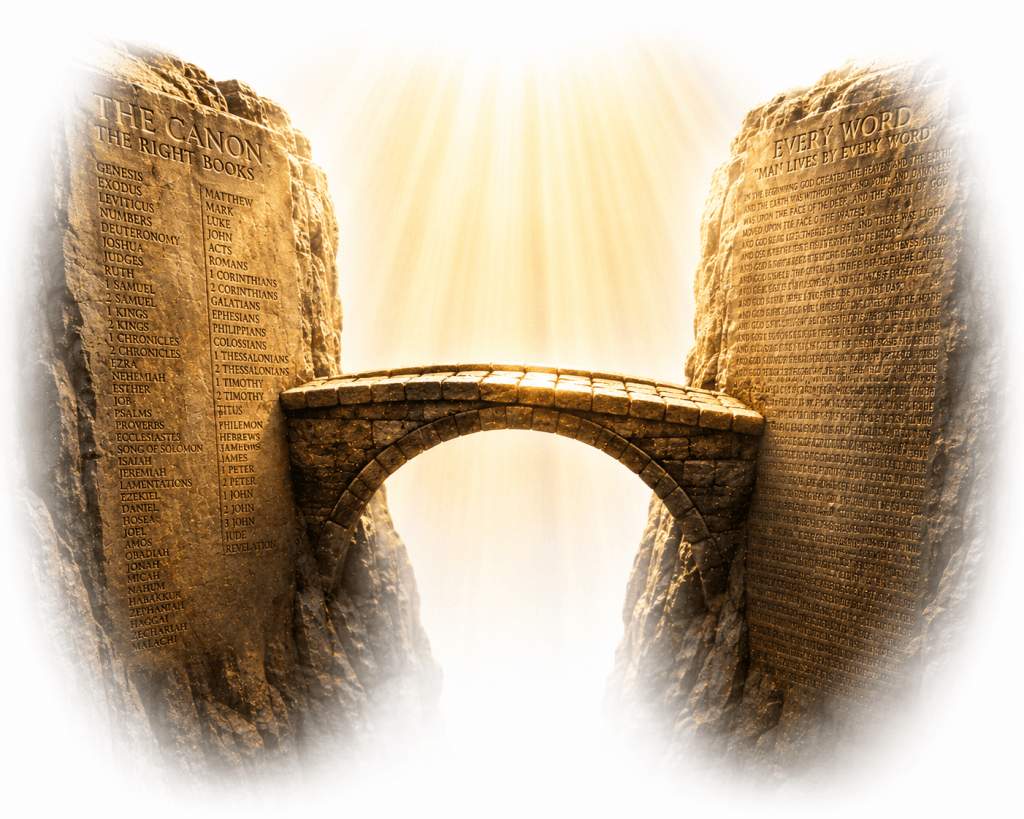
Yesterday the series announced the question that comes next and the volume that will take it up. Today we build the bridge, the bridge from the foundation this book has laid to the field the next book will enter. Because the two questions are joined, and seeing how they join is the whole point of this next-to-last day.
“But he answered and said, It is written, Man shall not live by bread alone, but by every word that proceedeth out of the mouth of God” (Matthew 4:4).
Every word. When Jesus answered the tempter in the wilderness, He did not say man lives by the general message of God, or by the books of God, or by the themes of God. He said man lives by every word that proceedeth out of the mouth of God. Human life itself hangs on the words, each of them. And if we live by every word, then it matters enormously not only which books contain God’s words, but whether the words within those books are the words God actually spoke. The canon question and the text question are joined at exactly this point: every word.
The Foundation Has Been Laid
Step back and see what this series has built. For twenty-seven days it has argued one thing: that the sixty-six books of Scripture are not a human invention but a divine gift, recognized, not constructed; received, not revised. The church’s task has always been to receive what God gave, not to edit it according to the preferences of the age.
That argument has been made. The canon is settled. The foundation has been laid, and a foundation is the right image, because a foundation is not the whole building. It is what the building stands on. Everything this series established, the recognized books, the closed canon, the sufficiency of Scripture, the call to stand and search, is foundation. It is solid, it is finished, and it is meant to bear weight.
But a foundation exists to be built upon. And the moment you have a settled foundation, a new question arises about what stands on it. The canon question asks: is this the right foundation, the right books? Answered: yes, sixty-six, settled forever. The next question asks: and what exactly is written on the stones of that foundation, the right words?
Why Right Books Are Not Enough by Themselves
Here is why the bridge is necessary, and why the text question cannot simply be waved off once the canon is settled.
Imagine you had established, beyond all doubt, exactly which sixty-six books belong in the Bible, and then discovered that the words within those books had been altered, added to, or quietly subtracted over the centuries, so that the text on your page no longer matched what the prophets and apostles actually wrote. You would have the right books and the wrong words. You would have won the canon question and lost something just as precious. A settled list of the right books, filled with uncertain or corrupted words, would be a hollow victory.
This is not a hypothetical worry invented to sell a second book. It is the natural, necessary implication of everything this series has said about the Word. We have insisted, day after day, that Scripture is God-breathed down to its words, verbal inspiration, not merely conceptual (Day 4). We have said that Jesus built arguments on a single verb tense and declared that not one jot or tittle would pass from the Law (Day 10). We have said that the Word is very pure (Day 21). If all of that is true, if inspiration reaches to the very words, and the words are pure, and man lives by every one of them, then the question which words? is not a distraction from the doctrine of Scripture. It is that doctrine taken seriously to its logical end.
You cannot say every word of God is pure and then be indifferent to which words are actually in front of you.
What Most Christians Have Never Been Told
And this is where the field opens up, because most Christians have never been told what lies in it.
The English Bible you hold is not simply the Bible. It is a translation of a particular collection of ancient manuscripts. And depending on which Bible you are reading, that collection may differ meaningfully from the one the Reformers translated from, the one your grandparents grew up on, or the one that carried the gospel to the nations. Different manuscripts. Different underlying texts. Different editorial decisions, made by different people, with different convictions about the very nature of the book they were handling.
The field has at least three parts, and the next volume will walk through each. There is the question of the manuscripts, when the tradition shifted, why the received text the church had used for over a thousand years was set aside in favor of a small cluster of documents recovered in the nineteenth century, and what the scholars who built the modern critical text actually believed about Scripture. There is the question of the products, that translations are owned, copyrighted, revised on schedules that coincide with new commercial editions, and shaped by committees whose convictions are rarely examined by the people who buy the results. And there is the question of the page itself, what happens when a verse that appears in one translation simply does not exist in another, when a phrase that anchors a doctrine quietly disappears between editions, when whole sentences drop to a footnote marked not in the earliest manuscripts, and the trusting reader assumes that means they do not belong.
These are not idle curiosities. They are the questions of a believer who has taken every word seriously, who, having searched out which books, cannot now be incurious about which words.
The Same Confidence, Carried Forward
One thing must be said clearly as we cross this bridge, because the field can look intimidating from its edge. The goal of the text question is not to unsettle you. It is not to leave you anxious about whether you can trust the Bible in your hands, or to send you into a fog of scholarly doubt. That would be the exact opposite of everything this series has built.
The goal is the same Berean confidence we have aimed at from the first day: to know rather than merely assume, to search rather than trust blindly, and to hold the pure Word with open eyes. The canon question, examined honestly, did not weaken confidence in the Bible, it grounded it, showing that the sixty-six books rest on solid historical ground and were recognized, not invented. The text question, examined with the same honesty, is meant to do the same for the words: to replace vague assumption with settled, evidence-based confidence about the Word we hold.
The God who superintended the recognition of the canon also superintended the preservation of its text. The same Providence that gave us the right books did not then lose the right words. The next volume follows the evidence of that preservation, carefully, honestly, without fear and without denominational combat, into the field that the foundation was always meant to support.
The foundation is laid: the right books. The field awaits: the right words. Tomorrow we look out over that field itself, the two streams of manuscripts that flow down to the Bibles of our own day.
“Man shall not live by bread alone, but by every word that proceedeth out of the mouth of God.” — Matthew 4:4 KJV
📖 This post is adapted from Canon and Covenant: How God Preserved His Word Through History. If it helped you, the full book is available on Amazon — or you can support this ministry directly.
thefinalconvergence.com | Follow on Instagram, Facebook, X, and YouTube
If you like to be updated on new blogs, sign up to our newsletter!


Leave a comment