
Published: September 20, 2026 | thefinalconvergence.com
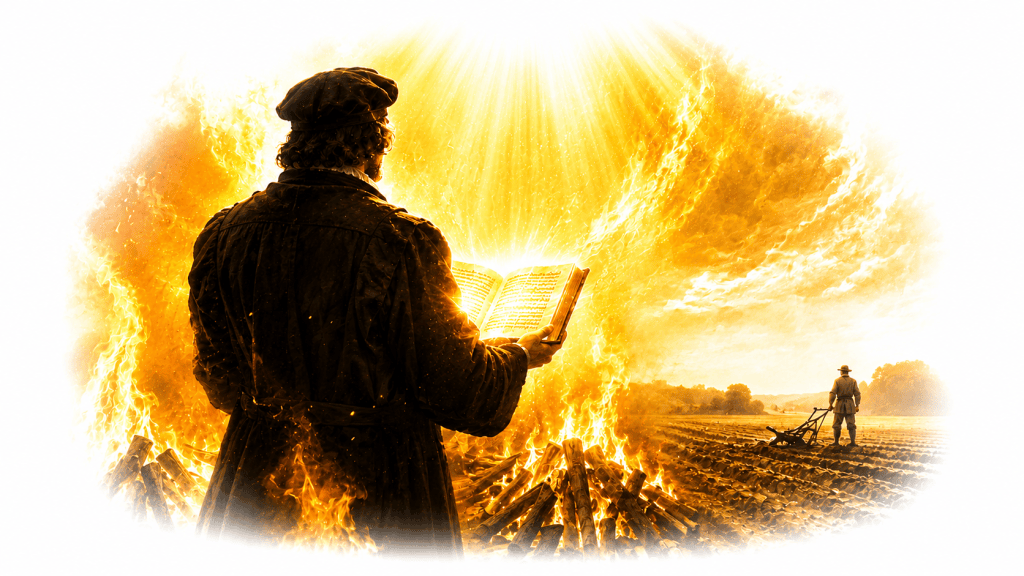
Yesterday we mapped the two streams of manuscripts. Today we follow the faithful stream as it flows into English, and we meet the men who carried it there, one of whom was strangled and burned at the stake for the crime of putting the Word of God into a language the plowboy could read.
Because here is a fact that reframes the whole modern debate: the King James Bible did not arrive in a vacuum. It was the culmination of nearly a century of extraordinary English translation work, all drawing from the same Majority Text tradition, each translation building on the shoulders of the last, each carrying the same conviction, that God had preserved His Word, and the church’s job was to faithfully transmit it, not reconstruct it.
“And ye shall know the truth, and the truth shall make you free” (John 8:32).
This is the promise the whole faithful stream was built to deliver. Not truth locked in a dead language, guarded by an institution, doled out in fragments to a laity kept deliberately dependent, but truth known, by ordinary people, in their own tongue, setting them free. Every man in this chapter believed that if the common person could simply read the Word for himself, the truth would do its liberating work. Some of them died on that conviction. And they were right.
William Tyndale (1494–1536): The Foundation
William Tyndale was the first person to translate the New Testament directly from Greek into English, working from the Erasmian text, the same Byzantine tradition that would become the Textus Receptus. His 1526 translation was so faithful, so readable, and so theologically precise that it became the immediate target of the English establishment, which understood exactly what an English Bible in ordinary hands would do: permanently undermine institutional control over the religious life of the nation.
He was a linguist of rare gifts. Miles Coverdale said Tyndale could speak seven languages, Hebrew, Greek, Latin, Italian, Spanish, English, and French, so perfectly that whichever he spoke, you would suppose it his native tongue. And he had a courage to match. When a clergyman argued that it was better to obey the Pope than the Bible, Tyndale answered that if God spared his life, before many years he would cause a boy who drove the plough to know more of Scripture than the clergyman did.
He was betrayed, arrested, and executed in 1536, strangled and burned at the stake in Vilvoorde, Belgium. His dying words, reported by John Foxe, were: Lord, open the King of England’s eyes. The prayer was answered with startling speed. Within six years, Henry VIII had ordered a copy of the English Bible, built substantially on Tyndale’s own translation, placed in every church in England.
And his legacy runs deeper than his martyrdom. Scholars estimate that roughly eighty percent of the King James New Testament is directly derived from Tyndale’s translation. When you read the KJV New Testament, you are largely reading the work of a man who gave his life so you could read it, a man working from the same Byzantine text the Greek-speaking church had preserved and used for a thousand years before him.
The Tradition of Careful Revision
Miles Coverdale published the first complete English Bible in 1535, drawing on Tyndale where his work was available and translating from Latin and German for the portions Tyndale never reached. Coverdale did not know Hebrew, and his Old Testament shows it in places, but he completed what Tyndale had begun and gave England its first printed Bible for general circulation.
What Coverdale established was a pattern: successive revision, each generation improving on the last without departing from the received textual tradition. That pattern continued through the Matthew’s Bible (1537), the Great Bible (1539, the first authorized for use in all English churches), and the Bishops’ Bible (1568), before reaching its height in the Geneva Bible and the King James Version. This is worth dwelling on, because it is the opposite of what the modern era would do. These revisions refined wording while holding the text constant. The stream deepened; it did not change course.
The Geneva Bible (1560): The Reformation’s Bible
The Geneva Bible was produced by English Protestant exiles who had fled to Geneva during the reign of the Catholic Queen Mary I. Working under the influence of John Calvin and Theodore Beza, the latter of whom also contributed to the Greek text underlying the KJV, they produced the first complete English Bible with verse numbers, chapter summaries, extensive marginal notes, and a thoroughly Reformed theological character.
It became the Bible of the Puritans, the Pilgrims, and the English Reformation. It was the Bible Shakespeare quoted. It was the Bible the Pilgrims carried to America on the Mayflower in 1620, and the Bible that shaped the first generation of New England Christianity. It was far more popular with ordinary readers than the official Bishops’ Bible, and its influence on both English prose and Protestant doctrinal clarity is incalculable. And like Tyndale’s New Testament, it stood fully in the faithful stream: the Masoretic Hebrew for the Old Testament, Beza’s edition of the Received Text for the New.
Here is a detail worth noticing, because it corrects a common myth. When King James I commissioned a new translation, it was not because the Geneva Bible was textually or theologically defective. It was not. His objection was to the marginal notes, which he felt encouraged resistance to royal authority, particularly the notes on ungodly rulers. He wanted a translation without the political commentary. The underlying textual tradition stayed exactly the same.
The King James Bible (1611): The Standard
The fifty-four scholars assembled for the KJV worked in six companies across Westminster, Cambridge, and Oxford, each responsible for a section of Scripture. Every company’s work was reviewed by all the others, then revised by a final committee of twelve, and only then submitted for publication, a process of cross-checking that few translation projects before or since have matched.
These were not ordinary scholars. Lancelot Andrewes, who led the Westminster Old Testament company, knew fifteen languages and had memorized the entire Old Testament in Hebrew; he opened each day’s work with hours of prayer. John Rainolds, who first proposed the project, had reportedly memorized the whole Bible in both Hebrew and Greek. Miles Smith, who wrote the translators’ preface, was said by contemporaries to have Hebrew “running out of his fingers’ ends.”
The New Testament was translated from the Textus Receptus, the same Byzantine tradition as Tyndale and Geneva. The Old Testament was translated from the Masoretic Hebrew, the text preserved by the Jewish scribes, the text Jesus and the apostles quoted. The translators followed fifteen rules, including consulting the previous English translations, seeking consensus across companies, and adding no marginal notes except linguistic ones.
The result was not a departure from the Reformation tradition. It was its finest expression, Renaissance scholarship joined to the reverence of men who trembled at the Word of God. And it has proven itself across four centuries: unchanged in substance, never revised out of existence, still read and memorized by millions, still bearing the fruit of transformation wherever it is preached in faith.
What the Faithful Stream Shares
Tyndale. Coverdale. The Matthew’s Bible. The Great Bible. The Geneva Bible. The Bishops’ Bible. The King James. They stand in one stream, the Byzantine Majority Text for the New Testament, the Masoretic Hebrew for the Old. And they share something deeper than a source text: every one was produced by men who believed the Bible was the Word of God, not an artifact to be reconstructed by scholarly committees, but a revelation to be faithfully transmitted by believing scribes.
They produced doctrinal stability rather than confusion. They bore the fruit of revival when preached in faith. They gave the English-speaking world a stable, accessible, doctrinally complete text that generations could memorize, live by, and die for. The stream was not flawless, each translation had minor imperfections the next revision sought to address. But the stream was faithful. The textual tradition was consistent. And the God who promised to preserve His Word was working through it.
This is the tradition. This is the inheritance. And it is exactly this stream that the modern translation enterprise deliberately departed from in 1881, when two scholars published a Greek New Testament built not on the tradition of the faithful church, but on manuscripts recovered from Roman Catholic archives and a monastery’s discard basket. That departure, the men who made it, and what it produced, is where we turn next.
Tomorrow, the turning point: Westcott and Hort, and the day the stream was diverted.
“And ye shall know the truth, and the truth shall make you free.” — John 8:32 KJV
📖 This post is adapted from Which Bible Can You Trust? Scripture, Manuscripts, and the Quest for the Most Trustworthy Text. If it helped you, the full book is available on Amazon — or you can support this ministry directly.
thefinalconvergence.com | Follow on Instagram, Facebook, X, and YouTube
If you like to be updated on new blogs, sign up to our newsletter!


Leave a comment