
Published: September 29, 2026 | thefinalconvergence.com
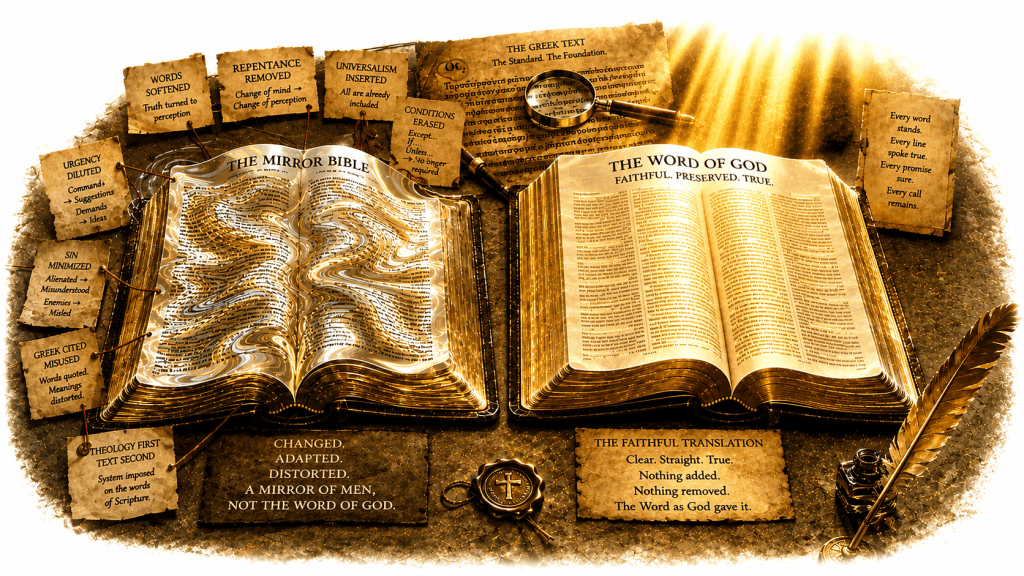
For twelve days we examined translations that lean, that shave a phrase here, soften a doctrine there, all in the same quiet direction. Today the series crosses into different territory. Part Four is about translations that have not merely leaned but crossed a line, texts where the problem is no longer a matter of degree but of kind. And the first of them is one of the most seductive, because it does not arrive wearing a villain’s face.
Not every corrupted Bible looks corrupt. Some of the most spiritually dangerous texts in circulation today read, at first encounter, like a fresh, liberating, beautifully written encounter with the love of God. The Mirror Bible is precisely this kind of danger, warm in its language, sophisticated in its presentation, and devastating in its implications for any reader who does not test it against the standard of the received Word.
“Beloved, believe not every spirit, but try the spirits whether they are of God” (1 John 4:1).
John does not say reject every spirit, and he does not say accept every spirit. He says test them, because deception in the church rarely announces itself. It comes clothed in spiritual language, warmth, and the vocabulary of grace. The command to try the spirits assumes that some things which sound beautiful and speak of God are nonetheless not of God. The Mirror Bible is a text that must be tested precisely because it sounds so good. And when it is tested against the Greek and against the whole counsel of Scripture, it fails.
What the Mirror Claims to Be
The Mirror Bible was produced by François du Toit, a South African pastor and author whose work grew out of the charismatic and Word of Faith streams. He is not a trained biblical scholar in the academic sense, but he writes with a theological fluency and spiritual warmth that have made him persuasive to audiences across South Africa, Australia, Europe, and increasingly North America, distributed through conferences, home groups, online platforms, and the broader “grace” and “hyper-grace” networks.
Crucially, du Toit presents the Mirror not as a commentary and not as an admitted paraphrase, but as a translation, a rendering of the Greek that supposedly recovers dimensions of meaning conventional translators missed. He cites Greek words and grammatical structures in his footnotes as justification. This gives the work an appearance of scholarly accountability that, on examination, is misleading. And that misleading appearance is exactly why it must be tested rather than simply admired.
The Framework Underneath
To see what the Mirror does to the text, you have to see the theology driving it. Du Toit works within a form of union mysticism joined to what he calls the “mirror principle,” the idea that Scripture’s function is to reveal to human beings their true identity as those already in union with God, already reconciled, already included in the divine life through the Incarnation.
On the surface this sounds like a rich development of Paul’s teaching on union with Christ, a theme genuinely present throughout Paul’s letters. But du Toit’s version moves decisively toward universal inclusion: the conviction that the Incarnation accomplished a permanent, universal union between God and all humanity, not potentially for all who believe, but actually for all, regardless of faith or repentance. In his framework, no one is outside God’s family. No one is perishing. No one needs to be saved in the ordinary evangelical sense. People only need to recognize what they already are.
At its logical end, this is a form of Christian universalism, the doctrine that all will finally be saved, which the overwhelming testimony of the church across two thousand years has identified as a departure from the plain teaching of Scripture. Du Toit avoids the word “universalism,” keeping his language positive, always about identity and discovery. But the practical result is the same: evangelism becomes unnecessary, repentance becomes a category error, and the urgency of faith in Christ’s atoning work quietly dissolves.
What the Mirror Does to the Words
Here is the fundamental problem, and it is not that du Toit holds unusual views, a commentator or preacher is free to argue a position and be answered. The problem is that his theological system is inserted directly into the translation of the text itself, so that readers who believe they are reading the Bible are actually reading du Toit’s system in biblical grammatical dress.
Consider John 3:3. Jesus tells Nicodemus: Except a man be born again, he cannot see the kingdom of God. That direct, urgent, second-person confrontation, you must be born again, is one of the most personal and searching statements in all the Gospels. It faces Nicodemus as an individual with a need only a divine work of new birth can meet. The Mirror dissolves that urgency into language about the Incarnation revealing what God always intended for everyone. The word except, which carries its plain conditional force in every other translation, is rendered so that the condition disappears. The result is a verse that no longer calls Nicodemus, or you, to anything. It merely announces what is supposedly already the case.
Consider metanoia, the Greek word translated repentance across two thousand years, in every language the New Testament has ever entered. It literally means a change of mind, a turning of the whole self from one direction to another, and in the Gospels it is always something required, what John the Baptist and Jesus demand, what unbelievers have not yet done and urgently must. The Mirror consistently renders it as an invitation to change one’s perception of what God has already accomplished, a shift in consciousness rather than a turning from sin. The call to repent becomes the suggestion to realize.
Consider Colossians 1:20-21. Paul writes of God making peace through the blood of his cross, and of the Colossians as sometime alienated and enemies in your mind by wicked works. The Mirror generalizes the reconciliation to all humanity and softens the alienation and enmity, the language of real human sin that makes reconciliation necessary, into something more like a temporary misunderstanding. The blood remains, but the context that makes the blood necessary, real sin, real wrath, real alienation, is progressively obscured. A ransom is left hanging in a story with no captivity.
Greek Citations as Decoration
The Mirror’s most effective device is its use of Greek. Du Toit regularly places Greek words in his footnotes beside his renderings, creating the impression that his choices rest on careful engagement with the original. But citing a word is not the same as interpreting it rightly. A Greek word can be quoted accurately and then assigned a meaning it does not carry, one no translator across twenty centuries has assigned it, and the citation still lends an air of authority.
Set du Toit’s citations beside the standard lexical resources, Thayer’s, BDAG, Liddell and Scott, and a consistent pattern appears: the words he cites are real words with real meanings, but the meanings he assigns are bent by his union-theology framework beyond anything the lexical range supports. He is not translating from the Greek. He is using the Greek as a decorative frame for a system decided before the translation began. This is exactly why 1 John 4:1 matters: the appearance of scholarship is itself part of what must be tested, because it is precisely the thing that disarms discernment.
Why the Danger Is Real
The Mirror’s primary audience is charismatic, contemplative, and post-evangelical, often sincere believers wounded in institutional settings and drawn to du Toit’s language of grace, identity, and love. And here is where the danger concentrates, because the danger is built on a real truth.
The biblical teaching on union with Christ is genuine and profound: believers are in Christ, sealed with the Spirit, unable to be separated from the love of God. That truth deserves to be proclaimed with power. The Mirror takes that real truth and stretches it past its biblical boundaries, removing the necessary conditions of personal faith and repentance, until it arrives at a “gospel” that calls no one to anything, because everyone is already included. A community formed on the Mirror will gradually lose the vocabulary to preach repentance, to call unbelievers to faith, to distinguish those in Christ from those who are not, or to take the coming judgment seriously. Those are not peripheral concerns. They are the heart of the apostolic mission, and they are systematically dissolved by a text that presents universal inclusion as the immediate meaning of the Incarnation.
The verdict is straightforward. The Mirror Bible is not a Bible. It is a theological system, union mysticism bordering on universalism, wearing the grammatical clothing of a translation. Its departures from the Greek are not translation-philosophy disagreements; they are a predetermined conclusion imposed on every passage that might challenge it. This is what it looks like to add to the words of God: not by inventing new verses, but by inserting a framework into the existing ones through renderings with no basis in the Greek and no precedent in the history of translation.
Read John’s actual Greek. Read Paul’s letters in any faithful translation. The God who breathed them out did not produce a text that needed François du Toit to rescue it from two thousand years of translators who missed the point. He produced a text perfectly capable of speaking its own meaning, including the meaning that some are perishing, and that all are urgently called to repentance and faith in the blood of the Lamb. Believe not every spirit. Try them.
Tomorrow, a different kind of danger: not a rewritten text, but a faithful text buried under a system of notes. Dake’s Annotated Reference Bible.
“Beloved, believe not every spirit, but try the spirits whether they are of God.” — 1 John 4:1 KJV
📖 This post is adapted from Which Bible Can You Trust? Scripture, Manuscripts, and the Quest for the Most Trustworthy Text. If it helped you, the full book is available on Amazon — or you can support this ministry directly.
thefinalconvergence.com | Follow on Instagram, Facebook, X, and YouTube
If you like to be updated on new blogs, sign up to our newsletter!


Leave a comment