
Published: September 30, 2026 | thefinalconvergence.com
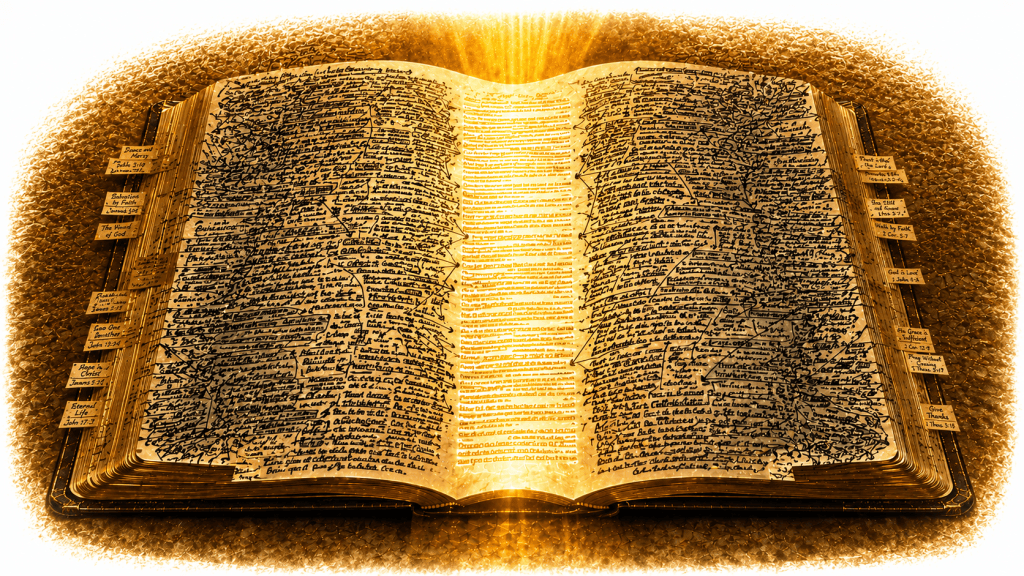
Yesterday’s danger was a rewritten text. Today’s is the opposite problem, and in some ways a subtler one. Dake’s Annotated Reference Bible uses a faithful text. Its underlying Bible is the King James Version, resting on the Received Text tradition this whole series has defended. So where is the danger in a Bible built on the right words?
The danger is not in the text. It is in everything printed around the text. And it teaches a lesson that applies far beyond this one edition: a Bible can carry the purest possible words and still lead a reader into serious error, if the interpretive framework wrapped around those words is corrupt.
“Study to shew thyself approved unto God, a workman that needeth not to be ashamed, rightly dividing the word of truth” (2 Timothy 2:15).
Paul’s charge is not merely to read the Word but to rightly divide it, to handle it accurately, to cut it straight. And that is exactly the issue with an annotation system. Notes are an act of dividing the word: they tell the reader how to cut it, where the lines fall, what each passage means. When the notes divide rightly, they serve the reader. When they divide wrongly, consistently, systematically, across the whole Bible, they do more damage than a bad translation, because the reader trusts them precisely as the guide to a text he already trusts.
A Sound Text, a Corrupt Apparatus
Give Dake’s Bible its due first. Unlike the Mirror, the Message, or the Passion Translation, Dake’s uses the KJV as its Bible text, genuinely to its credit. The words on the page are the faithful, complete, doctrinally sound Received Text rendering. If you read only the biblical text in a Dake’s Bible, you would be reading the Word of God faithfully preserved.
But almost no one reads only the text. Finis Jennings Dake (1902–1987) spent decades producing what he called the most thoroughly annotated reference Bible available, and in sheer volume that claim is probably true. Notes, cross-references, outlines, and doctrinal summaries surround virtually every verse in both Testaments. And for many readers, the notes effectively become the Bible. They do not read the passage and then weigh Dake’s comment on it; they read Dake’s comment as the meaning of the passage. That is the mechanism by which a Bible with a sound text can still lead people into error, not by corrupting the words, but by wrapping them in a corrupted framework the reader absorbs as authoritative.
The Man Behind the Annotations
When someone presents his theological system as the definitive interpretation of Scripture — when thousands treat his notes as trustworthy guidance on what the Bible means, the integrity of that guide becomes a relevant question. So the history has to be stated, carefully and without sensationalism.
Dake showed extraordinary gifts from childhood; by his own account he had memorized the entire New Testament in his teens, and he developed a genuinely encyclopedic knowledge of Scripture. He became an ordained Pentecostal minister associated with the Assemblies of God and pastored in Texas and Oklahoma. Then, in 1937, he was arrested and charged under the Mann Act, a federal law concerning the transport of a minor across state lines for immoral purposes. He pleaded guilty, served a federal sentence, and was removed from ministry by his denomination, which does not treat such findings lightly.
This is not raised as an ad hominem attack, and a man’s past does not automatically disqualify every word he ever wrote. It is raised because it bears directly on a specific claim the reader is being asked to accept: that this man is a credentialed, trustworthy guide to the very meaning of God’s Word. He is not the safe, authoritative guide many readers assume him to be, and, as we will see, the content of his annotations confirms that the caution is warranted on doctrinal grounds quite apart from his biography.
Three Gods, or One?
The most serious error in Dake’s system is his doctrine of God. Dake taught what can only be described as tri-theism, the belief that Father, Son, and Holy Spirit are three completely separate and distinct Gods, each with His own independent body, soul, and spirit. He taught that God the Father possesses a literal, physical body, that the Son is a separate God from the Father, and that the Spirit is a third separate God. His annotations steer readers toward this reading verse by verse.
This is not a variation within orthodox theology. It is a rejection of the Bible’s most foundational claim about God. The LORD our God is one LORD (Deuteronomy 6:4). There is one God, and one mediator between God and men, the man Christ Jesus (1 Timothy 2:5). To us there is but one God, the Father… and one Lord Jesus Christ (1 Corinthians 8:6). Scripture never speaks of three separate Gods, however exalted or distinct the Persons. When Dake reaches I and my Father are one (John 10:30), he explains the oneness away as mere agreement of purpose, the identical move made by ancient Arianism and by modern Jehovah’s Witness theology, not by the historic church. A reader who absorbs these notes as reliable will come away with a doctrine of God that places him outside the bounds of Christian orthodoxy on the most fundamental question there is: the nature of the God he prays to and is baptized into.
Racial Theology in the Margins
Woven through the annotations at several points is a second grave error: a racial theology arguing that God designed racial separation and that racial mixing violates divine order, presented as though it were the plain teaching of certain Old Testament passages.
Scripture teaches the opposite, and it is not ambiguous. There is neither Jew nor Greek… for ye are all one in Christ Jesus (Galatians 3:28). God hath made of one blood all nations of men for to dwell on all the face of the earth (Acts 17:26). The consummation itself is a great multitude, which no man could number, of all nations, and kindreds, and people, and tongues, standing before the throne (Revelation 7:9). The unity of all humanity in the image of God, and the unity of all believers across every ethnic line, runs from creation to consummation as a central thread of the whole biblical story. Dake’s racial theology contradicts the explicit text, and, unsurprisingly, it has made his Bible popular in certain segregationist communities. Any annotation that guides a reader toward the notion that racial separation is divinely ordained has departed not from one debatable interpretation but from the plain teaching of the very text it claims to explain.
The Deeper Lesson: When Notes Become the Bible
Beyond the specific errors, Dake’s Bible illustrates a danger that attaches to any heavily annotated study Bible: the annotation system quietly substituting for the reader’s own engagement with the text. Dake’s prophetic notes, for instance, construct elaborate timelines and charts that present the sequence of end-time events with a confidence and specificity the biblical text simply does not supply, one sincere interpretation among many, presented as the obvious meaning.
The structural problem is dependence. A reader who consults the note on every passage is no longer reading the Bible; he is reading Dake’s interpretation of the Bible, verse by verse, book by book, until the annotation becomes the primary text and the Scripture becomes merely the occasion for accessing it. That inverts the right relationship between Scripture and commentary, and it is most dangerous exactly when the commentary is systematically wrong on the doctrine of God and the unity of humanity in Christ.
So the verdict is unusual for this section, and worth stating precisely. You could read the KJV text in a Dake’s Bible with full confidence, it is the faithful Received Text, and no note can corrupt what the text preserves. But do not trust the notes. The test of any annotation is whether it illuminates the text or substitutes for it, whether it drives the reader deeper into the passage or channels him toward the annotator’s predetermined system. On the unity of God, the unity of humanity in Christ, and the nature of divine revelation, Dake’s notes fail that test. Rightly dividing the word of truth is the reader’s own responsibility before God, and it cannot be outsourced to a set of margins, however voluminous, that divide it wrongly.
Tomorrow, a paraphrase so loose that its author’s interpretation has entirely replaced the text: The Message.
“Study to shew thyself approved unto God, a workman that needeth not to be ashamed, rightly dividing the word of truth.” — 2 Timothy 2:15 KJV
📖 This post is adapted from Which Bible Can You Trust? Scripture, Manuscripts, and the Quest for the Most Trustworthy Text. If it helped you, the full book is available on Amazon — or you can support this ministry directly.
thefinalconvergence.com | Follow on Instagram, Facebook, X, and YouTube
If you like to be updated on new blogs, sign up to our newsletter!


Leave a comment