
Published: October 21, 2026 | narconnections.com
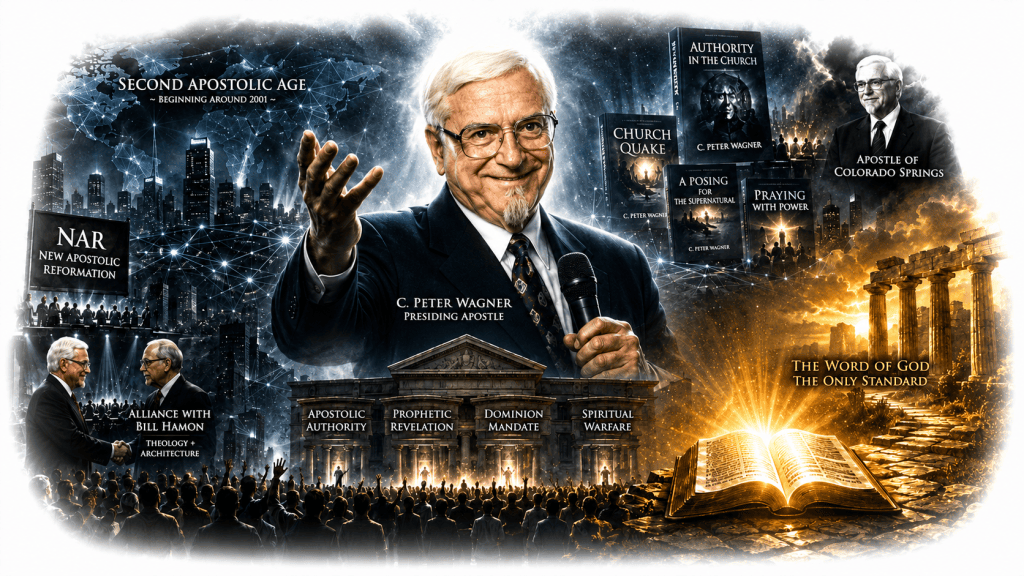
We now leave the foundations and begin naming names. And we begin where the modern movement itself begins, with a man of genuine academic accomplishment who spent the last decades of his life systematically dismantling the very convictions that had made him credible in the first place. If one figure supplied the theology of the New Apostolic Reformation, another supplied its architecture, its name, its institutions, and the respectable vocabulary that walked a set of condemned doctrines through the front door of mainstream evangelicalism. That architect was C. Peter Wagner. Every figure in the chapters ahead inhabits an institutional world that he built.
“And no man taketh this honour unto himself, but he that is called of God, as was Aaron” (Hebrews 5:4).
This is the Bible’s own rule for sacred office, and it is the exact rule Wagner’s life violated. The honor of holy office is not taken, it is given, by God, to the one He calls, “as was Aaron,” whom God appointed and who did not appoint himself. The whole logic of the verse is that a true office-holder is summoned to a place he would never presume to seize. Set that beside a man who announced a “Second Apostolic Age,” accepted for himself the title Presiding Apostle, and later declared himself Apostle of Colorado Springs, claiming apostolic jurisdiction over an entire city. Hebrews 5:4 is not an obscure proof-text here. It is the precise standard against which Wagner’s central act, the taking of an honor to himself that no man may take, is measured and found wanting.
The Scholar Before the Apostle
It is worth being fair about who Wagner was before he was “Presiding Apostle,” because the tragedy only lands if you see what was traded away. Born in 1930, he began his ministry not as a charismatic but as a cessationist, a missionary in Bolivia who, by his own later account, was initially hostile to the very Pentecostal phenomena he would spend his final decades promoting. On the mission field of Latin America he confronted the explosive growth of Pentecostal Christianity, and that confrontation set the course of his scholarly life.
He returned to the United States to join the faculty of Fuller Theological Seminary’s School of World Mission, where he became one of the most influential figures in the Church Growth Movement, working in the shadow of its founder, Donald McGavran. In this period Wagner was a serious academic. His books on church growth were widely read; his classroom carried weight; his name meant something in mainstream evangelical missiology. That reputation is exactly what he would later spend on the apostolic project, and it is precisely why that project succeeded where louder, less credentialed voices had failed. Note, too, that the worldwide instinct was there from the very start: Wagner’s entire frame was global, his questions were always about how movements spread across nations, and he would eventually apply that missiological imagination to the spread of apostolic networks across the earth.
The Wimber Turn
The reorientation began in the early 1980s through Wagner’s association with John Wimber and the Vineyard movement. At Fuller, the two co-taught a course on signs, wonders, and church growth that became one of the most controversial offerings in the seminary’s history, controversial enough that Fuller eventually suspended it. Through Wimber, Wagner encountered a theology in which miraculous manifestations were not the exceptional footnotes of church history but the expected, teachable, reproducible normal of Christian ministry.
For a scholar who had spent his career studying why some churches grow and others do not, the appeal was obvious: here, it seemed, was the engine of explosive growth he had documented in Latin America, now offered as a method. What began as academic curiosity became personal conviction, and the cautious missiologist began his long migration toward the movement he would one day name. This is a pattern worth marking, because it recurs throughout this book: the appetite for results, for growth, for power, for the visible and the dramatic, steadily eroding the discipline of testing, until the question “does it work?” quietly replaced the question “is it true?”
The Handshake That Built a Movement
The decisive moment came in 1992, when Wagner met Bill Hamon. Wagner would later write that before that encounter he had no inkling any such thing as a prophetic-apostolic movement existed. Hamon changed that. What Hamon carried, the Latter Rain doctrine of restored apostles and prophets governing the church with fresh revelatory authority, handed Wagner the theological key he had been missing.
The division of labor between these two men is the single most important structural fact in the movement’s formation. Hamon supplied the theology, rooted directly in the North Battleford revival of 1948. Wagner supplied the academic framework and the institutions to carry it worldwide. Wagner wrote forewords to Hamon’s books. He sat with Hamon on the Apostolic Council of Prophetic Elders. And he took the vision Hamon had carried through four decades of relative obscurity and gave it a name that would circle the world. Remember what we saw on Day 2, that the Latter Rain was condemned as heresy in 1949 and driven underground. Here is where it resurfaced: a condemned doctrine, kept alive by one man for forty years, handed to a credentialed academic who knew exactly how to make it respectable.
The Institutions
Wagner’s genius was institutional. Where Hamon trained prophets, Wagner built the structures that would credential, network, and legitimize apostles at scale. He founded an operational hub for apostolic prayer and what he called strategic-level spiritual warfare. He developed and popularized the practice of spiritual mapping, the identification of territorial demonic spirits said to rule over cities and nations, to be confronted by coordinated apostolic prayer. He co-founded the International Coalition of Apostolic Leaders as the movement’s primary credentialing and networking body, presiding over a worldwide roster of self-identified apostles. And he founded the institute later renamed Wagner University, the movement’s in-house academy, the source of the doctorates that figures across the network now use to lend scholarly weight to their work.
Notice the design. That coalition is, deliberately, a coalition without borders, binding apostolic leaders across every inhabited continent into a single networked structure. The interconnectedness this whole book documents was, for Wagner, not an accidental byproduct, it was the entire point. He was a missiologist to the end; he simply applied the science of how movements spread across nations to the spread of a movement Scripture never authorized.
Taking the Honor to Himself
And so we arrive back at Hebrews 5:4. Wagner announced that a Second Apostolic Age had begun around the year 2001, a new era in which God was restoring the government of the church to living apostles and prophets. He accepted for himself the title Presiding Apostle. He later claimed a form of territorial apostolic jurisdiction over cities. And he personally recognized and commissioned a generation of apostles who now lead the movement, figures whose apostolic identity traces, directly or at one remove, back to Wagner’s own recognition.
Weigh that against the text. No man taketh this honour unto himself. The New Testament apostle did not appoint himself; he was commissioned directly by the risen Christ, was an eyewitness of the resurrection, and bore the signs of an apostle, credentials no living person can claim and that Scripture never suggests would be reproduced. Wagner’s entire edifice rests on a single exegetical claim: that the offices of Ephesians 4:11 are permanent governing offices now being restored. But Ephesians 2:20 says the church is built upon the foundation of the apostles and prophets, with Christ as the chief cornerstone, and a foundation is laid once. The apostolic deposit is preserved, complete and sufficient, in Scripture. Wagner’s movement cannot accept that sufficiency, because sufficiency renders living apostles unnecessary, and his entire structure depends on their necessity. He did it all, moreover, with the calm, publication-laden confidence of a tenured professor. Which is exactly what made it persuasive, and exactly what makes it a case study in Hebrews 5:4: an honour taken, not given.
The Blur He Made Possible
Wagner’s most lasting achievement was one of respectability. The doctrines he institutionalized had been condemned by the Assemblies of God in 1949 and confined for decades to independent networks on the margins of Pentecostalism. Wagner took those same doctrines, dressed them in the vocabulary of missiology and church-growth science, attached his academic name to them, and moved them into the center of worldwide evangelical life.
In doing so, he dissolved the boundary that had kept Latter Rain restorationism outside the mainstream. Under his framework, an apostle could operate across denominational lines, credentialed by a coalition rather than a church, accountable to a network rather than a confession. That is the denominational blur in its purest institutional form: authority detached from any denomination, floating free across the whole evangelical world, answerable to no historic body. Wagner did not merely name the movement. He built the machine that let it cross every wall the churches had spent centuries constructing.
He died in October 2016, still holding the title of Presiding Apostle, still convinced he had helped inaugurate the most important development in the church in five hundred years. He left behind his coalition, his university, the spiritual-mapping and Seven-Mountain frameworks, and a generation of commissioned apostles who now lead the movement’s largest networks. He also left behind, unheeded, a warning the New Testament had already spoken long before he was born: that no man takes this honour to himself, and that some who transform themselves into the apostles of Christ are not what the title claims. The tragedy of C. Peter Wagner is not that he was a fool. It is that he was a gifted, credentialed, worldwide-minded scholar who took his good name and his academic vocabulary and used them to walk doctrines the church had condemned straight through the front door. That was the whole achievement, and every chapter that follows walks through the door he opened.
Tomorrow, the man who handed Wagner the key: Bill Hamon, the theological grandfather who carried the Latter Rain across seventy years.
“And no man taketh this honour unto himself, but he that is called of God, as was Aaron.” — Hebrews 5:4 KJV
📖 This post is adapted from NAR Connections: Connecting The Dots. If it helped you, the full book is available on Amazon — or you can support this ministry directly.
thefinalconvergence.com | Follow on Instagram, Facebook, X, and YouTube
If you like to be updated on new blogs, sign up to our newsletter!


Leave a Reply