
Published: October 20, 2026 | narconnections.com
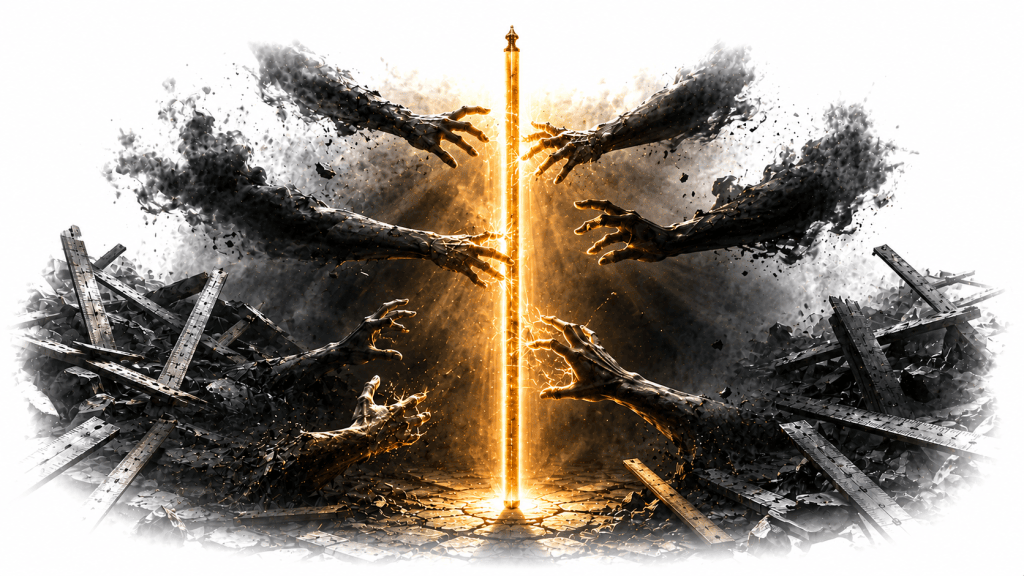
We come to the last day of foundations before we begin naming names. We have seen a movement that says it does not exist, that claims to have no history, and that rebuilds the government of the church around a restored apostolic office. Today we reach the deepest layer of all, the one move that makes every other error possible. It is not a doctrine the movement openly denies. It is a standard the movement quietly moves. And once you see how it is moved, every chapter that follows becomes legible.
“All scripture is given by inspiration of God, and is profitable for doctrine, for reproof, for correction, for instruction in righteousness: That the man of God may be perfect, throughly furnished unto all good works” (2 Timothy 3:16-17).
Here is the measuring rod itself, named, in a single sentence, by the apostle Paul. All Scripture is God-breathed, and it is profitable for four specific things: doctrine (what to believe), reproof (where we are wrong), correction (how to be set right), and instruction in righteousness (how then to live). And the result is total: that the man of God may be perfect, complete, lacking nothing, thoroughly furnished unto all good works. Sit with that word thoroughly. If Scripture furnishes the believer thoroughly for all good works, then nothing essential is missing from it. There is no gap for a living apostle to fill, no vacancy for a fresh prophecy to occupy, no deficiency for a new experience to supply. The sufficiency of Scripture is not a doctrine the movement can argue against directly, so it does something subtler. It leaves the rod on the wall, still honored in word, while it governs by another standard entirely.
The Standard That Was Quietly Moved
Doctrine matters. This is the claim the New Apostolic Reformation most consistently and most strategically contests, but never head-on, because arguing openly against doctrine would be too transparently unchristian. Instead, the movement redefines the measure of doctrinal validity. In its world, the measure of a ministry is its fruit, its anointing, its supernatural power, its capacity to generate revival experiences. Scripture’s own standard, conformity to the apostolic deposit preserved in the written Word, is not rejected outright. It is displaced: moved quietly from the center to the margin, still honored in word while another standard governs in practice.
Everything the movement gets wrong flows from that one displacement, and everything the church must recover begins with putting the rod back. The written Word of God is not one authority among several; it is the sole, sufficient, final rule of faith and practice, able to make the man of God complete. A living prophet who supplements it, an apostle who governs above it, a translation that quietly rewrites it, an experience that overrides it, each is simply a different way of removing the one measure Scripture will not permit to be removed. Today we name the four fault lines where that removal happens.
Fault Line One: The Prophetic Accountability Crisis
The movement’s claim that God still gives authoritative revelation through contemporary prophets would be far less dangerous if it kept the accountability mechanism the Bible builds into its own definition of prophecy. Deuteronomy 18:20-22 is unambiguous: a prophet who speaks in the name of the Lord and whose word does not come to pass has spoken presumptuously. The text offers no category of “conditional” prophecy allowing the prophet to revise his word after the fact, and no exemption for predictions that were mostly right. The prophet who speaks and is not vindicated has not spoken for God.
In place of that clear standard, the movement has manufactured a theology of partial prophecy, the idea that prophetic words are imperfect impressions filtered through the prophet’s personality, to be “weighed and sifted” rather than tested for truth and falsehood. Notice what this framework accomplishes. It transfers accountability from the prophet to the hearer. It shields the prophet from the consequences of error. And it ensures no prophetic claim can ever be definitively falsified. The results are documented and traceable: when numerous recognized prophets across the network declared with confidence that a recent presidential election would go a certain way, and it did not, a few offered brief apologies and were back to issuing declarations within weeks, while most defended their words as conditional or misunderstood, and the movement’s leadership offered no correction. The prophets kept their platforms. The conferences kept inviting them. Nothing changed. A prophetic culture that cannot be wrong is a prophetic culture that cannot be trusted.
Fault Line Two: Signs and Wonders Above the Word
Beneath the prophetic crisis lies a deeper inversion. Scripture makes the supernatural the subject of theological evaluation; the movement makes it the standard of evaluation. Where the Bible insists that a sign proves nothing on its own, that false prophets and lying spirits can produce wonders, the movement treats healing, prophetic accuracy, gold dust, and manifestation as the decisive evidence that God endorses a ministry. Once the miraculous becomes the validation rather than the object of discernment, biblical correction becomes nearly impossible: any challenge can be answered by pointing to the power, and the very act of testing the spirits gets recast as unbelief.
The witness of Scripture on this point is not subtle. Pharaoh’s magicians reproduced the first signs of Moses. The Lord Jesus warned that many would say to Him in that day that they had prophesied and cast out devils and done many wonders in His name, and would hear Him answer, I never knew you. Paul foretold a coming lawless one whose arrival is with all power and signs and lying wonders. If wonders could validate a ministry, not one of those warnings would make sense. The consistent teaching of Scripture is that a sign authenticates nothing apart from the truth of the message it accompanies, that the question is never merely “did something happen?” but “is this in accord with sound doctrine?” A movement that has trained its people to be persuaded by the marvel and to distrust the one who asks the doctrinal question has disarmed them at the exact point where Scripture told them to stand guard.
Fault Line Three: The Seven Mountain Mandate
The third fault line has the most immediately observable real-world consequences. The Seven Mountain Mandate, developed and popularized by Lance Wallnau, taught by Bill Johnson, and drawing on earlier language from Loren Cunningham and Bill Bright, holds that Christians are to exercise apostolically directed dominion over seven cultural mountains: religion, family, education, government, media, arts, and business. This is not a fringe idea taught by peripheral figures. Chris Hodges has taught it. Andrew Wommack has embedded it in the curriculum of his Bible college and welded it to a candidate-training political coalition. Bill Hamon runs an entire division of his ministry to advance it. These are among the most institutionally significant leaders in the movement’s American expression, teaching this doctrine to the next generation of church leaders at scale.
And its fruit is documented: the reframing of elections as spiritual warfare, and the capture of institutions treated as a divine mandate. But the substitution at its heart is the real problem. The Great Commission sends the church to make disciples, baptizing and teaching. It does not send her to seize the mountains of civilization. Trading the first commission for the second is among the movement’s gravest errors, because it redirects the church’s entire energy from the salvation of souls to the capture of cultural power, and calls that redirection obedience.
Fault Line Four: The Counterfeit Bible
The fourth fault line is the boldest stroke of all, and it must at least be named here, though it earns a full chapter later in this series: the alteration of Scripture itself. The Passion Translation, produced by Brian Simmons, an apostle within one leader’s network, a professor at another’s unaccredited university, and a member of a third’s prophetic council, systematically embeds the movement’s vocabulary and theology into the biblical text while presenting itself as a translation.
See why this is the logical end of everything the previous three fault lines began. If the measuring rod can be displaced by prophecy, overridden by experience, and reframed by dominion, then the final step is to alter the rod itself, so that the reader who turns to Scripture to test the movement finds the movement already written into his Scripture. When the standard of correction has itself been corrupted, the ordinary believer is left genuinely defenseless. He opens his Bible to check what he is hearing and finds the check has been quietly disabled. This is precisely why the recovery of a trustworthy, sufficient Bible is the first and last answer to everything this book documents, and why the volume before this one was devoted entirely to it.
Why This Chapter Comes Before the Names
Put the four fault lines together and a single strategy comes into view: displace the measure, override it, reframe it, and finally rewrite it. Each is a different way of removing the one standard Scripture will not allow to be removed. And that is why this chapter had to come before we name a single architect. Everything that follows, Wagner’s institutions, Hamon’s prophetic empire, Bethel’s worship, the celebrity-pastor web, the conference circuit, is built on the removal of the measuring rod. Once the rod is back on the wall and in your hand, the whole network becomes measurable. You will be able to hold each figure, each teaching, each song up against the God-breathed Word that furnishes the man of God thoroughly for all good works, and to see, plainly, where each one departs from it.
That is the entire method of this book, and of this series. Not “does this ministry have power?” Not “is this teacher anointed?” Not “did something miraculous happen?” But the one question the movement has trained a generation to stop asking: is this in accord with the sufficient, God-breathed Word? Keep that measure in your hand for the twenty-six days ahead, and no architect, however impressive, will be able to move it out of your grip.
Tomorrow, the first architect: C. Peter Wagner, the cautious missiologist who spent the last decades of his life trading a respected academic career for a self-conferred title, and who built the machine every figure in this book now inhabits.
“All scripture is given by inspiration of God, and is profitable for doctrine, for reproof, for correction, for instruction in righteousness: That the man of God may be perfect, throughly furnished unto all good works.” — 2 Timothy 3:16-17 KJV
📖 This post is adapted from NAR Connections: Connecting The Dots. If it helped you, the full book is available on Amazon — or you can support this ministry directly.
thefinalconvergence.com | Follow on Instagram, Facebook, X, and YouTube
If you like to be updated on new blogs, sign up to our newsletter!


Leave a Reply