
Published: October 22, 2026 | narconnections.com
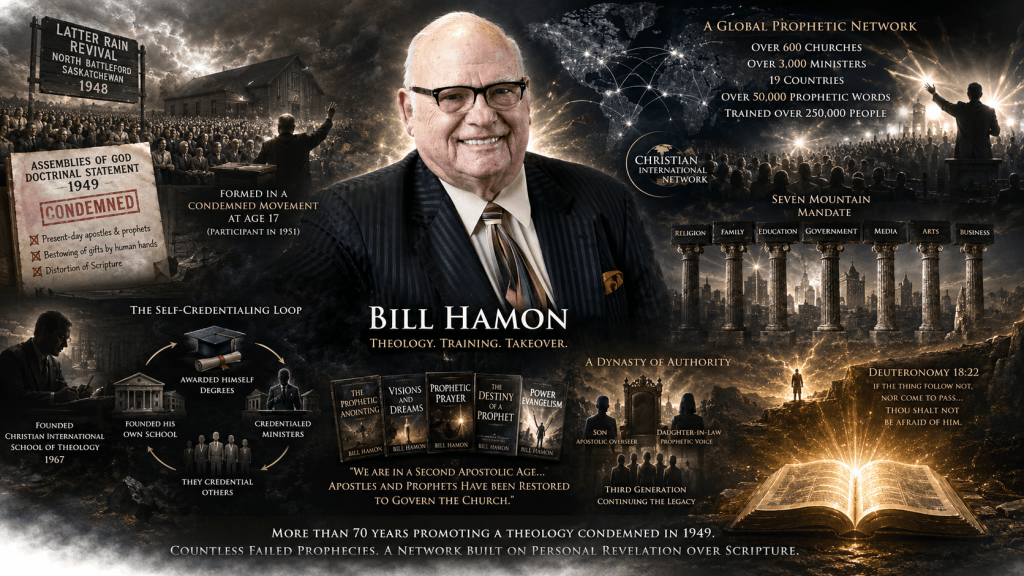
Yesterday we met the architect who built the movement’s institutions. Today we meet the man who handed him the blueprint. Because C. Peter Wagner did not invent the theology of the New Apostolic Reformation, by his own admission, before 1992 he did not even know such a movement existed. He got the framework from someone else: a man who had been carrying it, unbroken, since he was seventeen years old. If Wagner is the architect, this man is the grandfather — the living bridge across which the doctrines of a movement condemned in 1949 traveled, intact, into the twenty-first century. His name is Bill Hamon.
“When a prophet speaketh in the name of the LORD, if the thing follow not, nor come to pass, that is the thing which the LORD hath not spoken, but the prophet hath spoken it presumptuously: thou shalt not be afraid of him” (Deuteronomy 18:22).
This is God’s own test for a prophet, and it is devastatingly simple. It does not ask whether the prophet is sincere, gifted, influential, or beloved. It asks one question: did the thing he said in the LORD’s name come to pass? If it did not, the verdict is fixed, the LORD hath not spoken it, and the man hath spoken it presumptuously. And note the final clause, so easily overlooked: thou shalt not be afraid of him. The failed prophet is not to be feared, deferred to, or protected. He is to be dismissed. Hold this test in your hand for the whole of today, because Bill Hamon has spent more than seventy years building a movement of prophets, and the movement’s prophecies, again and again, have failed the exact test Deuteronomy 18:22 sets.
Formed Inside a Condemned Movement
The most important fact about Hamon is not the scale of his operation, remarkable as that is. It is his formation. He did not weigh the Latter Rain’s claims as an adult and then decide to embrace them. He grew up inside them. Born in 1934, converted at sixteen at a 1950 revival meeting in Oklahoma, he became a participant in the Latter Rain Movement in 1951, when the movement was only four years old and he was seventeen.
That detail is the master key to the man. The Latter Rain had erupted in February 1948 in North Battleford, Saskatchewan, among leaders inspired by the healing meetings of William Branham, a revivalist who was a modalist, and by Franklin Hall’s teaching that extended fasting could produce bodily immortality. From that soil grew the whole cluster: restored governing offices of apostle and prophet, impartation of spiritual gifts by the laying on of hands, personal directive prophecy as the church’s primary authority, and the “Manifest Sons of God” teaching. The Assemblies of God condemned these teachings in 1949, objecting to present-day apostles and prophets, the bestowing of gifts by human hands, and the distortion of Scripture the system required. The condemnation did not kill the movement; it drove it underground. And Bill Hamon is the man who carried it there, not as an outside observer who adopted it, but as a teenager formed by it, who spent the rest of his life institutionalizing what he had absorbed before he was old enough to evaluate it.
The Self-Credentialing Loop
Hamon pastored his first church at nineteen and, in 1967, founded the Christian International School of Theology, the institution from which he then awarded himself a bachelor’s and a master’s of theology. A later honorary doctorate, from an institution his own ministry website declines to name, furnished the title “Dr. Hamon” he has used ever since.
Look closely at that sequence, because it is the self-credentialing loop in its purest form: a man who founded the school that granted his own degrees, and then uses those degrees to credential the ministers he ordains, who in turn credential others, a closed circle of authority with no external point of verification anywhere in it. This is the accountability vacuum from Day 3 made concrete in a single biography. There is no presbytery, no ordination board, no confessional body, no examining authority standing outside the man to test him. He is his own school, his own faculty, his own credentialing agency, and the fountainhead of everyone else’s credentials in the network. When authority is a closed loop, error has no way in from the outside, and no way out.
The Christian International Empire
From that base Hamon built an empire. Christian International, headquartered today in Santa Rosa Beach, Florida, exercises formal apostolic oversight of more than six hundred churches and three thousand ministers across nineteen countries. By his own count, Hamon has personally prophesied to more than fifty thousand individuals and trained more than a quarter of a million people in prophetic ministry. He holds membership in both of the movement’s central governing bodies. He founded a suite of subsidiary networks, among them a dedicated Seven Mountain Mandate arm, embedding dominionist theology at the organizational level, so that every minister the ministry trains carries it as standard equipment.
And he runs the whole thing as a dynasty: his son serves as apostolic overseer of the family church, his daughter-in-law is a widely published prophetic figure in her own right, and the credentialing passes down the bloodline into a third generation. Keep the two threads of this book in view. The scale is the worldwide-web thread, nineteen countries, a quarter-million trained. The dynasty is the accountability thread, authority passed by blood rather than by the examination and confirmation of the wider church, exactly as a family business passes a company, not as Scripture passes the pastoral office.
The Living Bridge
Here is why Hamon matters more than almost anyone else in this book. Most figures are nodes — people shaped by the movement’s ideas who pass them along. Hamon is the through-line. He is listed among the Kansas City Prophets, the network gathered around Mike Bickle in the 1980s whose members, Bob Jones, Paul Cain, carried the Branham–Latter Rain prophetic culture into the era just before the NAR. Paul Cain had himself been a follower of Branham. So the continuity is unbroken: mid-century healing revival → the Latter Rain → the Kansas City Prophets → the modern apostolic movement, and Bill Hamon is the one figure who spans all of it. He supplied the historical legitimacy that grounded the Kansas City Prophets in a longer tradition, and he supplied the ground-level infrastructure that trained and deployed prophets by the hundreds of thousands while the celebrities operated at the apex.
This is the answer, in one man, to the question Day 2 raised. When the movement claims to be a fresh, unprecedented work of the Spirit, Hamon’s seventy-year career is the living refutation. The doctrines did not descend from heaven in the 1990s. They came from a Canadian schoolhouse in 1948, and one seventeen-year-old carried them, unbroken, into the century that followed.
The Load-Bearing Error
The concerns with Hamon’s theology are not secondary quibbles. They strike at the foundation of biblical authority. The load-bearing error is his teaching that modern apostles and prophets carry the same revelatory authority once given to the writers of Scripture, that the anointing for divine revelation given to the prophets of old has now been given equally to the church’s apostles and prophets today.
Follow that where it leads. If it is true, the canon is not closed; every accredited prophetic word carries the weight of Isaiah or Romans, and the movement’s leaders speak for God in a direct, binding, ongoing way. But Scripture says otherwise, plainly and repeatedly. Hebrews declares that God, who spoke in time past through the prophets, has in these last days spoken by His Son. Revelation closes with a curse on any who add to the words of the book. Peter grounds the church’s confidence in the written prophetic word already delivered, not in fresh private revelation. The doctrine of ongoing, canon-level revelation is not a Protestant conviction at all, it is a mark of the movements that have always sought to add to the sufficient Word. From this one root grow the rest of Hamon’s errors: a Manifest Sons of God / “Joel’s Army” eschatology in which an end-time company of glorified believers subdues the earth before Christ returns (inverting the whole shape of biblical eschatology, which ends the age with the return of the Lord Jesus in glory, not the church’s seizure of cultural power); a self-flattering “Third Reformation” that places the movement in Luther’s lineage (though Luther’s Reformation was a return to Scripture against human tradition, and Hamon’s is a departure from Scripture’s sufficiency toward ongoing human utterance); and an entire industry of “activating” prophetic gifts through the laying on of hands, transforming what Scripture presents as the Spirit’s sovereign distribution, dividing to every man severally as He wills, into a trainable, transferable skill dispensed by an organization for a fee.
The Test He Cannot Pass
And so we return to Deuteronomy 18:22, because it is the test the whole edifice was built to evade. The Latter Rain’s prophecies failed. The Kansas City Prophets’ predictions failed repeatedly. The confident post-2020 declarations of a guaranteed election outcome, issued by prophets across Hamon’s own network, failed comprehensively. Through all of it, the framework survived — not because it passed the biblical test, but because the movement had quietly replaced that test with an “inner witness” that can never be falsified.
But God left no room for an inner witness that overrides the outcome. When a prophet speaketh in the name of the LORD, if the thing follow not, nor come to pass… the prophet hath spoken it presumptuously. The standard is the event, not the sincerity. And the final clause is the believer’s charter: thou shalt not be afraid of him. The whole apparatus of “honor,” “covering,” and “touch not the Lord’s anointed” exists to make you afraid to apply the test, afraid that to question the prophet is to sin. Deuteronomy 18:22 cuts that fear off at the root. A prophet whose words fail is not to be feared. He is to be recognized for what the text plainly calls him: one who has spoken presumptuously. Bill Hamon built a seventy-year movement of prophecy. Measured by the one test God actually gave, the movement does not survive its own record, and every believer who values the sufficiency of Scripture has a duty to understand what this movement is, where it came from, and who built it.
Tomorrow, the spider at the center of the web: Bill Johnson and Bethel Church, the single most influential institution the movement has produced.
“When a prophet speaketh in the name of the LORD, if the thing follow not, nor come to pass… the prophet hath spoken it presumptuously: thou shalt not be afraid of him.” — Deuteronomy 18:22 KJV
📖 This post is adapted from NAR Connections: Connecting The Dots. If it helped you, the full book is available on Amazon — or you can support this ministry directly.
thefinalconvergence.com | Follow on Instagram, Facebook, X, and YouTube
If you like to be updated on new blogs, sign up to our newsletter!


Leave a Reply