
Published: October 30, 2026 | narconnections.com
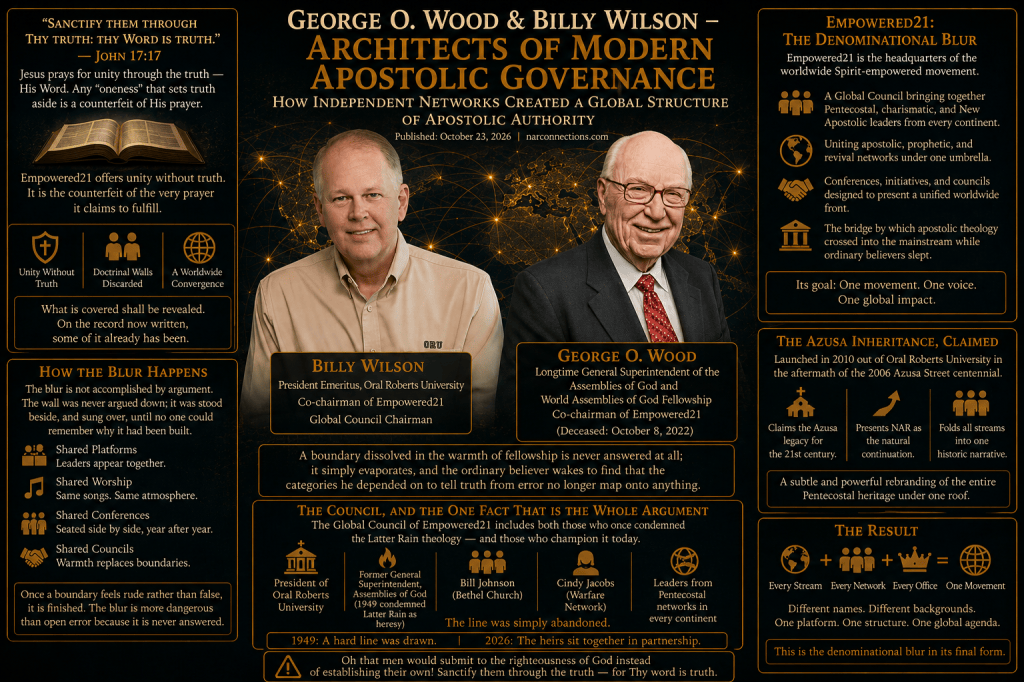
Every network we have examined so far does a particular work, credentialing apostles, training leaders, planting churches, sustaining a revival family. But there remains a larger ambition, one standing above all the rest: to gather the entire worldwide Spirit-empowered movement, Pentecostal, charismatic, and New Apostolic alike, into a single, coordinated, worldwide front. That ambition has an address. It is called Empowered21, and it is the headquarters of the denominational blur this whole book exists to trace. If you retain one institution from this entire series, retain this one, because Empowered21 is the mechanism by which everyone is knit back together into one.
“Sanctify them through thy truth: thy word is truth” (John 17:17).
This is the Lord Jesus praying for His church on the night before He died, and it is the single most important verse for understanding what Empowered21 is and is not. In the same prayer, Jesus asks that His people would be one, and the movement quotes that plea constantly to justify its convergence. But watch how Jesus asks for their oneness. He asks the Father to sanctify them, to set them apart, to make them one, through thy truth, and then He defines that truth with total precision: thy word is truth. The unity Christ prays for is not unity instead of truth, or unity purchased by softening truth. It is unity created by the truth, and the truth is the Word of God. Hold that against Empowered21, because Empowered21 offers the church a different unity entirely, a oneness achieved not by gathering around the Word but by quietly setting aside the doctrinal walls the Word once built. It is the counterfeit of the very prayer it claims to fulfill.
The Council, and the One Fact That Is the Whole Argument
Empowered21 is governed by a Global Council, and the identity of its leadership is the entire argument of this book compressed into a single fact. It has been co-chaired by Billy Wilson, the president of Oral Roberts University, and it has long included George O. Wood, the former general superintendent of the Assemblies of God, the very denomination that condemned the Latter Rain in 1949 as heresy. Around that same council gather figures documented throughout this series: Bill Johnson of Bethel, Cindy Jacobs, and the leadership of Pentecostal and charismatic networks from every inhabited continent.
Consider what is seated at that one table. A church built on condemned Latter Rain theology, now nondenominational. The historic denomination that issued the condemnation. A revival-movement prophetess who directs a fifty-state warfare network. A worship empire franchised across the world. And the leadership of classical Pentecostal bodies from every continent. All of them, on one governing council, presenting a unified worldwide front. This is not the picture of groups that happen to cooperate. It is the picture of a boundary that has ceased to exist. In 1949 the Assemblies of God drew a hard line against restored apostles, imparted gifts, and personal directive prophecy. Empowered21 seats the heirs of that denomination beside the most prominent living propagators of exactly those doctrines, as partners in a common enterprise, with no retraction of the old condemnation and no defense of the old boundary. The line was simply abandoned.
How the Blur Actually Happens
This is the most important thing to understand about the denominational blur, and Empowered21 shows it in its purest form: the blur is not accomplished by argument. No one answered the 1949 objections. No council reconvened, weighed the doctrines of the Latter Rain against Scripture, and formally withdrew the condemnation. The old objections were never refuted, they were simply rendered awkward, and then forgotten.
That is how it always happens. The wall was never argued down; it was stood beside, and sung over, until no one could remember why it had been built. Two leaders share a platform. Their people share a worship set. A conference seats them side by side, and then a council seats them together year after year, and the warmth of shared experience quietly accomplishes what no theological argument ever could: it makes the old boundary feel not wrong but rude, an embarrassment, a relic of a less generous age. And once a boundary feels rude rather than false, it is finished, because no one will defend it. This is why the blur is so much more dangerous than open error. Open error can be answered. A boundary dissolved in the warmth of fellowship is never answered at all; it simply evaporates, and the ordinary believer wakes to find that the categories he depended on to tell truth from error no longer map onto anything.
The Azusa Inheritance, Claimed
Empowered21 did not appear from nowhere. It was launched in 2010 out of Oral Roberts University, timed to the aftermath of the 2006 centennial of the Azusa Street Revival, the 1906 Los Angeles outpouring regarded as the birthplace of worldwide Pentecostalism. That framing is deliberate and revealing. By presenting itself as the custodian of the Azusa legacy for a new century, the organization claims the entire Pentecostal heritage as its inheritance, and folds the New Apostolic Reformation into that heritage as its natural continuation.
See what this accomplishes, because it is subtle and powerful. It erases the very distinction this book has labored to document. The difference between historic Pentecostalism and the modern apostolic movement is quietly dissolved into a single “Spirit-empowered” family with one shared centennial story, so that Bethel and the Assemblies of God appear not as condemned doctrine and condemning denomination, but as cousins celebrating a common birthday. It is a masterstroke of positioning: adopt the respected grandparent, and the disreputable cousin is suddenly family. The reader who grasps this understands why the movement is so hard to name and expose. It has wrapped itself in the honored heritage of a century ago, so that to question it feels like questioning Azusa itself.
Continental by Design, and Total by Ambition
Empowered21 is also the fullest institutional expression of this book’s other current, the worldwide web, because its cross-continental reach is not a byproduct but its very architecture. The organization is deliberately structured into regional councils spanning North America, Latin America, Europe, Africa, the Middle East, and Asia, each coordinating the Spirit-empowered leadership of its region and reporting into the worldwide body. Anchored by a university that hosts Global Congresses drawing leaders from scores of nations, it is the interconnectedness documented throughout this series, formalized into an organizational chart, the movement’s conviction that it is a single worldwide phenomenon, given a governing structure to match.
And its ambition is not merely geographic but total. Empowered21’s own stated goals reach well past evangelism and into the transformation of society itself. It declares its aim to raise up next-generation leaders in, in its own words, “every segment of society,” and it names them: church, family, government, business, education, arts and entertainment, sports, and media. That list is not incidental. It is the Seven Mountain Mandate, restated as plain organizational mission. So Empowered21 is not merely coordinating a worldwide revival; it is openly committed to raising up leaders to occupy every sphere of human culture, the same dominion vision that runs from Wagner through the Seven-Mountain popularizers to the halls of political power, here written into the founding purpose of the movement’s largest coordinating body. The blur is not only denominational and continental. It is, by its own declaration, a plan to take the mountains of the world.
Why It Is the Keystone
Empowered21 matters more than any single apostle or school because it is where the whole system is knit into one. The credentialing coalitions supply its apostles. The unaccredited universities supply its leaders. The revival family and the church-planting networks supply its congregations and platforms. The worship empires supply its songs. And Empowered21 gathers all of it, across every denominational line the churches once maintained and every continental distance that once separated them, into a coordinated worldwide front under a single council. It is the reason the movement cannot be dismissed as a scattering of eccentric American ministries. It is a governed, worldwide, self-conscious enterprise with an address, a council, a plan, and a hub, drawing the historic Pentecostal denominations and the newest apostolic networks alike into one body. When the world’s dominant Spirit-empowered worship brand, a historic Pentecostal denomination, a nondenominational revival empire, and a fifty-state prophetic warfare network all appear under one umbrella, that umbrella has become the single most important convergence point in worldwide charismatic Christianity. It is not that these groups agree on doctrine. It is that doctrine has ceased to be the thing that determines who stands together.
And for the ordinary believer, the practical consequence is disorienting and urgent. A generation ago, a denominational label carried real information, it told you what a church confessed and roughly where it stood. Empowered21 is the institutional proof that this shortcut no longer works. The Assemblies of God congregation down the road may be led by a pastor seated beside Bethel on a Global Council; the nondenominational plant may be governed by “apostolic elders”; the worship the whole town sings may flow from a single revival empire. The label on the sign tells you less than it ever has. What remains is the older, harder, unfailing work of testing each teaching, each song, and each leader against Scripture, the work this movement’s convergence has made not optional but urgent.
One Faith, One Test
And so we return to the prayer of Christ. The movement presents this whole convergence as the fulfillment of Jesus’ prayer that His people would be one. But the unity for which Christ prayed is unity in the truth. He did not pray, “sanctify them through their shared experience”; He prayed, “Sanctify them through thy truth: thy word is truth.” The oneness He asked for is a people set apart by the Word and gathered around it, the apostolic doctrine once delivered to the saints, guarded and confessed. A unity purchased by dissolving the boundaries that once protected sound doctrine is not the unity of the Spirit. It is its counterfeit: a single body organized around a shared feeling rather than a shared confession, with no wall left standing to keep error out. That is precisely what Empowered21 is, the answer to Christ’s prayer, offered by setting aside the very thing Christ said would make His people one.
This is why the blur that Empowered21 embodies makes discernment so difficult, and so necessary, in this hour. When the historic denomination and the condemned doctrine sit on one council, the label can no longer tell you where you stand. You are left with the only instrument that never fails, the Word of God, rightly divided, and the sober command that runs through this entire book: prove all things; hold fast that which is good. Christ’s people are made one by the truth, and the truth is His Word. Any oneness that requires you to set the Word aside is not the answer to His prayer. It is the thing His prayer was given to protect you from.
That closes Part Three, the institutions. We have seen the machine that credentials the apostles, the networks that carry them into the mainstream, and now the headquarters that gathers them all into one worldwide front.
Tomorrow we begin Part Four, and turn to the faces most of the church actually knows: the celebrity pastors, beginning with the export that reached your church through its songs, Brian Houston and Hillsong.
“Sanctify them through thy truth: thy word is truth.” — John 17:17 KJV
📖 This post is adapted from NAR Connections: Connecting The Dots. If it helped you, the full book is available on Amazon — or you can support this ministry directly.
thefinalconvergence.com | Follow on Instagram, Facebook, X, and YouTube
If you like to be updated on new blogs, sign up to our newsletter!
Back to NAR Connections Blogseections.com | thefinalconvergence.com | @tfconvergence on Instagram, Facebook, X, and YouTube


Leave a Reply