
Published: October 29, 2026 | narconnections.com
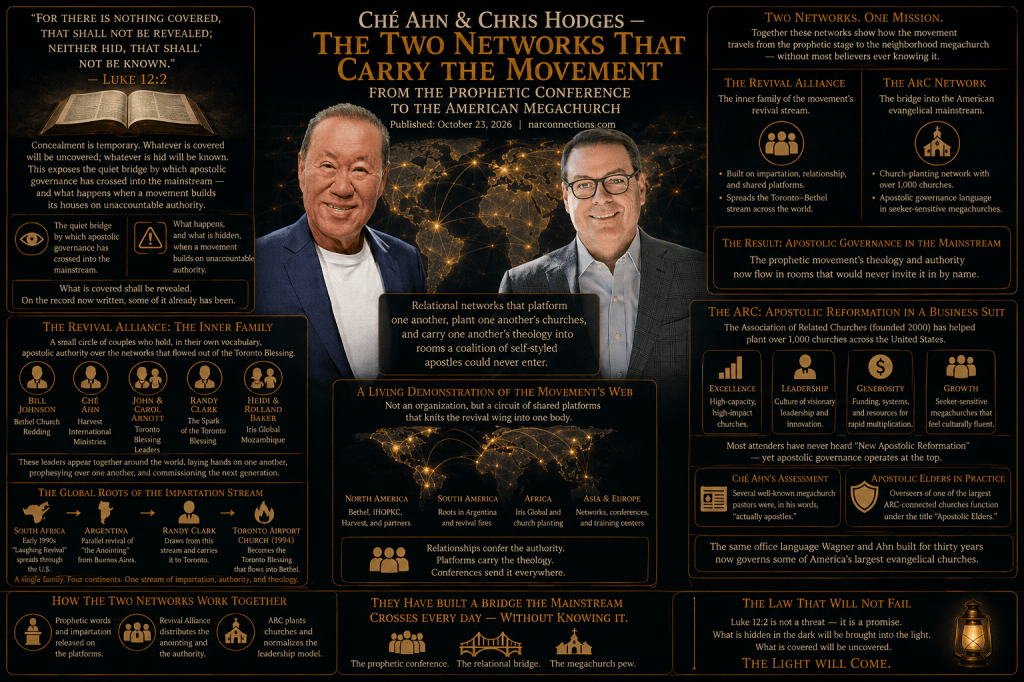
Yesterday we saw the machinery that manufactures apostolic titles. But a machine that stamps out credentials cannot, by itself, spread a movement across the mainstream of a nation’s churches. That requires something warmer and harder to see: relational networks, alliances of trusted leaders who platform one another, plant one another’s churches, and carry one another’s theology into rooms a coalition of self-styled apostles could never enter. Two such networks matter above the rest. One binds the movement’s revival core into a single family; the other carries the apostolic framework straight into the American evangelical mainstream, into bright, growing, culturally fluent churches whose members have never heard the phrase “New Apostolic Reformation.” Between them, they show how the movement travels from the prophetic conference to the neighborhood megachurch.
“For there is nothing covered, that shall not be revealed; neither hid, that shall not be known” (Luke 12:2).
This is the Lord Jesus stating a law as fixed as gravity: concealment is temporary. Whatever is covered will be uncovered; whatever is hid will be known. Nothing stays in the dark forever, not a hidden doctrine quietly imported into a mainstream church under a friendlier name, and not a hidden sin protected by the very structure that should have exposed it. Hold this verse over today’s chapter, because it cuts in both directions. It exposes the quiet bridge by which apostolic governance has crossed into the mainstream while ordinary believers slept, and it stands over the far graver thing this chapter must finally confront: what happens, and what is hidden, when a movement builds its houses on unaccountable authority. What is covered shall be revealed. On the record now written, some of it already has been.
The Revival Alliance: The Inner Family
The Revival Alliance is the inner family of the movement’s revival stream, a small circle of couples who hold, in their own vocabulary, apostolic authority over the networks that flowed out of the Toronto Blessing. Its core includes Bill Johnson; Ché Ahn; John and Carol Arnott, who led the Toronto revival; Randy Clark, whose ministry sparked it; and Heidi and Rolland Baker, whose Iris Global operates out of Mozambique. Reading that roster is reading the movement’s revival genealogy in miniature. Toronto flows into Bethel through Johnson’s 1995 impartation; Bethel and Ahn’s Harvest network join in the Revival Alliance and again in Wagner University; the Bakers extend the same stream into Africa. It is a single family whose members appear together on platforms across the world, conferring on one another the authority they claim, and carrying the Toronto-Bethel spirituality, impartation, manifestation, presence over proclamation, onto every continent they reach.
And the genealogy reaches further back, and further south, than Toronto, it runs through Argentina. The impartation stream that erupted at the Toronto Airport church in 1994 was not born there; it flowed from an interlocking “anointing” movement of the early 1990s, in which a South African evangelist, Rodney Howard Browne, spread a “laughing revival” through the United States, an Argentine pastor, Claudio Freidzon, ignited a parallel revival of “the anointing” from Buenos Aires, and Randy Clark drew from that stream and carried it to Toronto, where it became the Toronto Blessing that then flowed into Bethel. The revival family is older and more worldwide than its Redding-and-Toronto center suggests; its roots run through three continents at once. What holds it together is not an office or a headquarters but a circuit of shared platforms, the same couples headlining the same conferences year after year, laying hands on one another, prophesying over one another, jointly commissioning the next generation. It is a living demonstration of the cross-continental web: a handful of families whose personal relationships knit the movement’s revival wing into one body spanning four continents, each conferring on the others the very authority they all claim.
The ARC: Apostolic Reformation in a Business Suit
The Association of Related Churches is a different kind of network, and in some ways a more consequential one. Founded in 2000, the ARC is a church-planting organization that has helped launch over a thousand churches across the United States, supplying new plants with funding, systems, branding, and a launch model of remarkable effectiveness. Its public face is not apostles and prophets and prophetic decrees. It is excellence, leadership, generosity, and growth, the polished, contemporary, seeker-sensitive megachurch at its most attractive. Most people who attend an ARC-planted church have never heard the phrase “New Apostolic Reformation” and would be baffled to learn their church had any connection to it.
Yet the connection is documented in the movement’s own words. As we saw on Day 8, Ché Ahn has stated plainly that several well-known megachurch pastors were, in his assessment, actually apostles, and the overseers who governed one of the largest ARC-connected churches have functioned under the title “Apostolic Elders.” That vocabulary is not incidental. It is the precise language of the office framework Wagner and Ahn spent thirty years building, now operative at the governing level of some of the largest churches in American evangelicalism. This is the movement’s most successful bridge into the mainstream: hundreds of thousands of weekly attenders in bright, growing, culturally fluent churches, governed, in the estimation of the movement’s own operational heir, by men who hold apostolic office, whether or not their congregations have any idea.
Why the Excellence Is What Carries It
The ARC’s launch model is worth understanding, because its very effectiveness is what carries the theology so quietly. A new church is planted with substantial seed funding, a proven systems playbook, professional branding, and a coordinated “big launch” engineered to open with a large crowd rather than the handful a traditional plant begins with. It works, ARC churches launch larger and survive longer than the industry norm. But here is the thing to see: the same relational network that supplies the money and the systems also supplies the theology and the governance vocabulary. The founding families interlock; the same names recur across one another’s boards and platforms and pulpits. So a pastor who joins the ARC for its excellence and its launch model is joined, whether he intends it or not, to the relational web through which apostolic self-understanding travels. The systems come with a spirituality attached, and the spirituality is the one this book has been tracing.
This is the denominational blur operating at its most effective, precisely because it does not announce itself. No pastor signs a statement affirming restored apostolic offices. No congregation votes to adopt Seven Mountain dominionism. The theology arrives bundled with the excellence, in the launch playbook, the leadership conference, the governance vocabulary, the interlocking relationships, and it does its work invisibly, in exactly the churches least likely to suspect it. What is covered travels farthest.
The Test a Network Cannot Study For
A network is revealed not by its growth but by how it handles catastrophe, and the ARC’s founding circle has now furnished the test in the gravest form imaginable. This must be spoken plainly and on holy ground, because a child was harmed. Robert Morris, founder of Gateway Church, one of the most powerful figures in the entire orbit, and a spiritual advisor to a sitting president, resigned from Gateway in June 2024 after a woman publicly recounted that he had sexually abused her beginning when she was twelve years old. In March 2025 an Oklahoma grand jury indicted him; in October 2025 he pleaded guilty, receiving lifetime registration as a sex offender and an order to pay the survivor. An independent investigation found that multiple church leaders had known the abuse involved a minor and had failed to act; elders were removed. The man the movement’s own heir had named an apostle, whose network helped plant a thousand churches, was found to be a child abuser whose own church’s leadership had, in part, protected him.
Weigh that against Luke 12:2, and weigh it soberly. There is nothing hid that shall not be known. For years it was covered, and then it was revealed, as Christ said it must be. But notice how it came to light: not through the network’s own accountability mechanisms, but as in the cases of Lakeland and the Kansas City Prophets before it, when others finally forced it into the open. This is the same pattern documented throughout this book, now at the very summit of the mainstream bridge. A framework that concentrates enormous, self-validating authority in men accountable to no external body, and that trains its people to receive those men as anointed of God, not to be questioned, will produce exactly this fruit, and will lack the mechanisms to catch it until civil authorities do. The tragedy is not that the movement contains sinners; every church does. The tragedy is structural: a system built to shield its leaders from accountability worked precisely as built, and a child bore the cost.
What Scripture Required, and the Cost of Ignoring It
When Scripture requires that an overseer be blameless and of good report, and that accusations against an elder be heard and sin rebuked before all, it is not erecting bureaucratic hurdles. It is protecting the flock, and the most vulnerable within it, from precisely what the apostolic networks were structured to permit. Every safeguard the movement discarded in the name of apostolic authority was a safeguard God had placed there for the protection of the weak.
And the scandal did not stand alone. In the same season, a striking number of megachurch leaders across the movement’s mainstream bridge stepped down amid allegations of misconduct, and the pattern came into focus: large, admired, rapidly grown churches, governed by small circles of mutually loyal men, operating on the apostolic assumption that the anointed leader is not to be questioned. That assumption is not incidental to the model, it is imported with the “apostolic elder” vocabulary itself. A congregation trained to see its founding pastor as an apostle, carrying an office of extraordinary God-given authority, is a congregation disarmed in advance of the very scrutiny that might have protected it. The excellence and the growth are real. So is the theology of unaccountable authority riding quietly inside them, and so, now, is the cost.
The Verse Over the Whole Chapter
Set the two networks side by side and Luke 12:2 governs both. The Revival Alliance shows the movement’s theology traveling openly among those who embrace it; the ARC shows it traveling covertly into those who never asked for it — bundled with the funding, the systems, and the excellence, entering churches under a friendlier name. For years that importation stayed hidden, precisely as its quietness intended. But nothing covered stays covered. The apostolic governance riding inside the mainstream bridge is being revealed; the concealed sin that the structure was built to protect has, in the gravest case, already been dragged into the light of a courtroom. Christ said it would be. It always is.
This is why the whole book presses toward a single instrument. A movement is judged not by the size of the churches it plants, but by what it does when the man it called an apostle is found to have abused a child, and on that test, the record is now written. The safeguard was never the network’s excellence, its growth, or its anointing. The safeguard was the thing the movement traded away: authority that is examined, distributed, and answerable, standing under a Word that exposes what men would keep hidden.
Tomorrow, the headquarters where the whole worldwide movement is knit into one: Empowered21, the address of the blur.
“For there is nothing covered, that shall not be revealed; neither hid, that shall not be known.” — Luke 12:2 KJV
This entry touches on the abuse of a child. If this is part of your own story, you are not alone, and help is available; please reach out to someone you trust or a qualified professional.
📖 This post is adapted from NAR Connections: Connecting The Dots. If it helped you, the full book is available on Amazon — or you can support this ministry directly.
thefinalconvergence.com | Follow on Instagram, Facebook, X, and YouTube
If you like to be updated on new blogs, sign up to our newsletter!


Leave a Reply