
Published: October 31, 2026 | narconnections.com
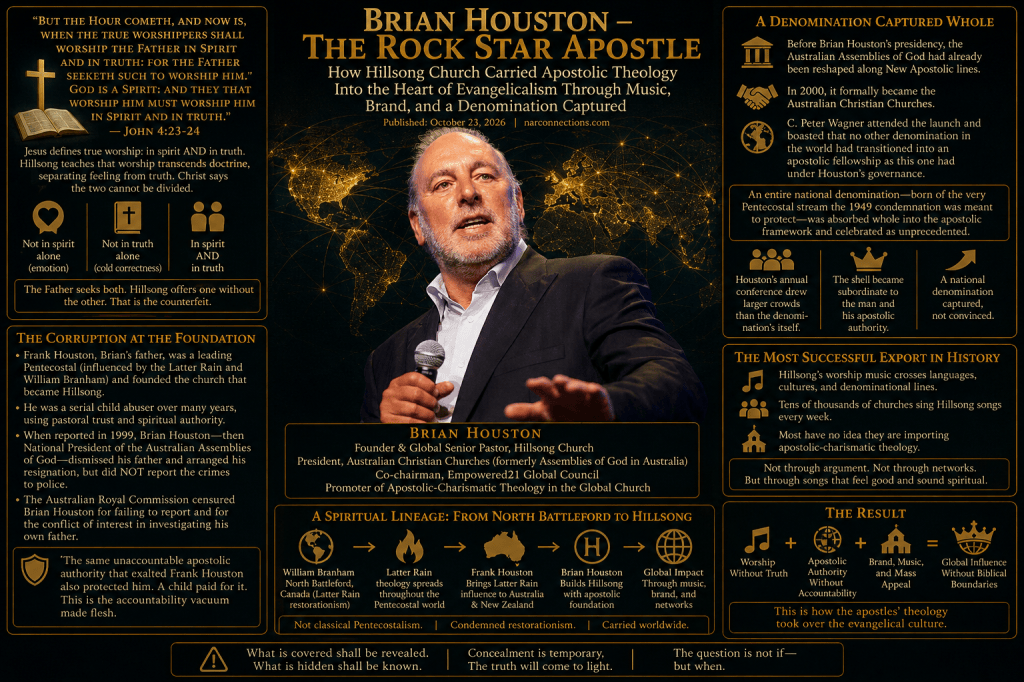
We now begin Part Four, and turn from the institutions to the faces, the celebrity pastors most of the church actually knows. And we begin with the figures who achieved something none of the architects did. Bill Johnson, Ché Ahn, and the rest spread the movement’s theology through apostolic networks and prophetic councils, reaching mainly those already inclined to receive it. Brian Houston and Hillsong Church require a different kind of attention, because they accomplished the most successful export of apostolic-charismatic theology in the history of Christianity, packaged not in books or sermons or conferences, but in music, and carried not through networks and councils but through worship teams in tens of thousands of churches that had no idea what they were bringing through the door. To understand how the movement captured the ordinary evangelical Sunday, you must understand Hillsong.
“But the hour cometh, and now is, when the true worshippers shall worship the Father in spirit and in truth: for the Father seeketh such to worship him. God is a Spirit: and they that worship him must worship him in spirit and in truth” (John 4:23-24).
This is the Lord Jesus defining true worship for all time, and He does it with a phrase He repeats twice for emphasis: in spirit and in truth. Not in spirit alone, not sincere feeling, moving atmosphere, or emotional intensity by itself. And not in truth alone, not cold correctness without the heart’s engagement. The Father seeks worshippers who bring both: genuine spiritual affection and conformity to what is actually true about God. Hold this verse over Hillsong, because Hillsong’s entire strategy, stated openly by its own founder, was built on the conviction that worship transcends doctrine, that the feeling can be separated from the truth and carried across every doctrinal line. Christ says the opposite. He says the two cannot be divided, that worship in spirit without truth is not the worship the Father seeks at all. That single divide is the whole of today’s chapter.
The Corruption at the Foundation
To understand Hillsong you must begin before Brian Houston, with his father, and with a matter that must be spoken plainly and on holy ground, because children were harmed. Frank Houston was a New Zealand Pentecostal who rose to lead the Assemblies of God there before moving to Sydney in 1977 to plant the church that would grow into the Hillsong network. He was not a theologically neutral figure: he had absorbed the influence of the Latter Rain and its prototype prophet William Branham, the modalist healing revivalist from Day 2, and carried that restorationist framework into the Australian and New Zealand Pentecostal world. This is the spiritual lineage of Hillsong: not classical Pentecostalism, but the condemned restorationism of North Battleford, planted in the southern hemisphere.
Frank Houston was also, across those same decades, a serial child abuser, who used the pastoral trust his charismatic authority generated to gain access to children over many years. When the abuse was reported to the church in 1999, Brian Houston was National President of the Assemblies of God in Australia. He dismissed his father and quietly arranged his resignation, but neither he nor the executive reported the crimes to police. Australia’s Royal Commission into institutional child sexual abuse later censured Brian Houston for failing to report and for the plain conflict of interest in investigating his own father while leading the denomination. And here is the theological point, which is not incidental to Hillsong but foundational to it: the very authority structure that made Frank Houston an unquestioned apostolic figure, the concentrated authority, the absence of genuine external eldership, the “touch not God’s anointed” culture, is the same structure that made him unaccountable. These are not merely doctrinal errors floating in the abstract. They are child-protection failures waiting to happen. What this whole book has called an accountability vacuum is, at the foundation of Hillsong, exactly that, and a child paid for it.
A Denomination Captured Whole
By the time Brian Houston assumed the presidency of the Australian Assemblies of God, the denomination had already been substantially reshaped along New Apostolic lines, and the reshaping had Wagner’s explicit blessing. When the Australian Assemblies of God formally became the Australian Christian Churches in 2000, C. Peter Wagner attended the launch and boasted afterward that no other denomination in the world had transitioned into an apostolic fellowship as this one had under Houston’s governance.
Read that boast as the confession it is. An entire national denomination, born of the very Pentecostal stream the 1949 condemnation was meant to protect, had been absorbed whole into the apostolic framework, and the movement’s own architect celebrated it as unprecedented. This is the denominational blur documented at its most complete. It is not, as at Empowered21, a wall quietly abandoned in shared fellowship. It is an entire denomination captured, on another continent, and paraded as a triumph. Houston built an apostolic authority base within the denominational shell until the shell was subordinate to the man, his own annual conference drawing larger crowds than the denomination itself.
The Deliberately Shallow Foundation
Houston’s theology was a synthesis of prosperity gospel and dominionism in mainstream-friendly packaging. In 1999 he published a book titled You Need More Money, arguing that God wills financial abundance for His people; when the prosperity label later became a liability, he denied it, though the title, the content, and decades of preaching contradict the denial. Hillsong promotes the Seven Mountain Mandate under the name “the Seven Spheres,” calling believers to take dominion over government, media, arts, business, education, family, and religion, cultural conquest in place of the Great Commission, directly at odds with Christ’s own refusal of earthly kingship.
But the most revealing thing Houston ever said was an admission about the foundation beneath it all. He acknowledged that Hillsong does not “build strong on theology,” keeping its net deliberately broad. Sit with that. A church that makes its doctrine deliberately vague in order to maximize its reach has not chosen humility over dogma; it has chosen market appeal as its governing principle. That is not the model of any office named in Ephesians 4. It is the model of a successful religious entertainment brand. And it is the necessary precondition for everything the music would go on to accomplish, because a theology kept deliberately thin travels through doctrinal walls a thick one never could.
How the Music Did What No Sermon Could
The music is how Hillsong accomplished what no amount of preaching ever could. By recruiting professional talent and mastering the forms of stadium pop, Hillsong Music placed its songs, “What a Beautiful Name,” “Oceans,” “Mighty to Save,” and dozens more, into the worship services of a vast cross-section of the worldwide church, selling tens of millions of albums and, by the ministry’s own estimate, having its songs sung by more than forty-five million people every week in American churches alone.
Consider what that means. In thousands of Reformed, Baptist, Presbyterian, and Anglican congregations, where no Hillsong pastor has ever preached and no Hillsong doctrine has ever been formally taught, Hillsong music is nonetheless sung every Sunday, written by musicians formed in prosperity theology, apostolic governance, and Kingdom-Now dominion. And Houston named the strategy himself: he wanted to shape the way people do church, observing that where doctrine and theology divide, “worship tends to transcend all of that.” That single sentence is the key to the entire enterprise, and it is precisely what John 4:23-24 forbids. It is not a neutral remark about the emotional power of music. It is a deliberate plan to build a pan-denominational, post-doctrinal Christian culture, one in which the Hillsong brand is embedded so deeply that to question Hillsong feels like an attack on the worship of God Himself. The theology rides in on the melody, and the melody has already been welcomed. When a congregation’s worship depends on Hillsong’s songs, that congregation has been captured, not by an argument it could examine, but by a chorus it loves. Bethel replicated the strategy exactly; Elevation extended it to new audiences. Hillsong pioneered it, and it worked.
The Structure That Failed at Every Level
Hillsong’s worldwide expansion ran on an invisible economy of mutual endorsement: it invited the biggest names in American evangelicalism to share its stages, and in exchange those names lent Hillsong their credibility while gaining access to its enormous young audience. The breadth of the resulting network, prosperity teachers, mainstream megachurch pastors, popular authors, pop celebrities, even heads of state across several continents, is itself a measure of how completely Hillsong operated as a platform that transcended theological categories, exactly as Houston intended.
Then the structure failed at every level. The celebrity pastor of Hillsong’s New York flagship was dismissed in 2020 amid revelations of lavish spending and minimal accountability. In 2022 Houston himself permanently stepped down after an internal investigation found he had behaved inappropriately toward two women, and after he was criminally charged with concealing his father’s crimes. Parliamentary disclosures alleged extravagant misuse of church funds, and the American campus network largely disintegrated, most of its congregations departing. The same lesson written across Lakeland, the ARC, and the Kansas City Prophets is written here again, at the summit of the worship world: concentrate unaccountable authority in a charismatic man, train a movement to receive him as anointed, and the collapse is not a surprise. It is the design, arriving on schedule.
What Remains: The Music
Here is the sobering part. Brian Houston no longer leads Hillsong, and his successor, raised entirely within the same system, holding the same prosperity and dominion theology, offers institutional and financial reform without any theological reform at all. A church with better accountability structures and the same false gospel has not been fixed; it has been reorganized. But the empire’s most dangerous legacy is not what has fallen. It is what still stands in tens of thousands of churches that sing the songs every Sunday, whose worship leaders play “Oceans” and “What a Beautiful Name” because the congregation loves them and no one has taught them what the songs carry.
The music outlasts the scandal, it always has. And every Sunday a congregation sings a Hillsong song without knowing whose theology shaped the words in its mouth, Hillsong’s true mission, to make its theology the ambient theology of Christian worship worldwide, is still being fulfilled. This is why John 4:23-24 is the verse to carry out of this chapter. The Father is not seeking worship that is merely moving. He is seeking worshippers who worship in spirit and in truth, and He seeks them, Jesus says, actively: the Father seeketh such to worship him. A worship culture built on the premise that the spirit can be separated from the truth, that the feeling can travel while the doctrine is left deliberately thin, is not producing the worshippers the Father seeks. It is producing exactly the ones Houston aimed to produce: millions moved in spirit, formed in a theology they were never told they were absorbing. The remedy is not to stop worshipping. It is to know what you are singing, to bring the truth back to the spirit, so that the worship is once again the kind the Father actually seeks.
Tomorrow, the master of manufactured wonder, and the most-watched preacher of the streaming age: Steven Furtick and Elevation.
“God is a Spirit: and they that worship him must worship him in spirit and in truth.” — John 4:24 KJV
This entry references the abuse of children. If this is part of your story, you are not alone, and help is available; please reach out to someone you trust or a qualified professional.
📖 This post is adapted from NAR Connections: Connecting The Dots. If it helped you, the full book is available on Amazon — or you can support this ministry directly.
thefinalconvergence.com | Follow on Instagram, Facebook, X, and YouTube
If you like to be updated on new blogs, sign up to our newsletter!


Leave a Reply