
Published: November 2, 2026 | narconnections.com
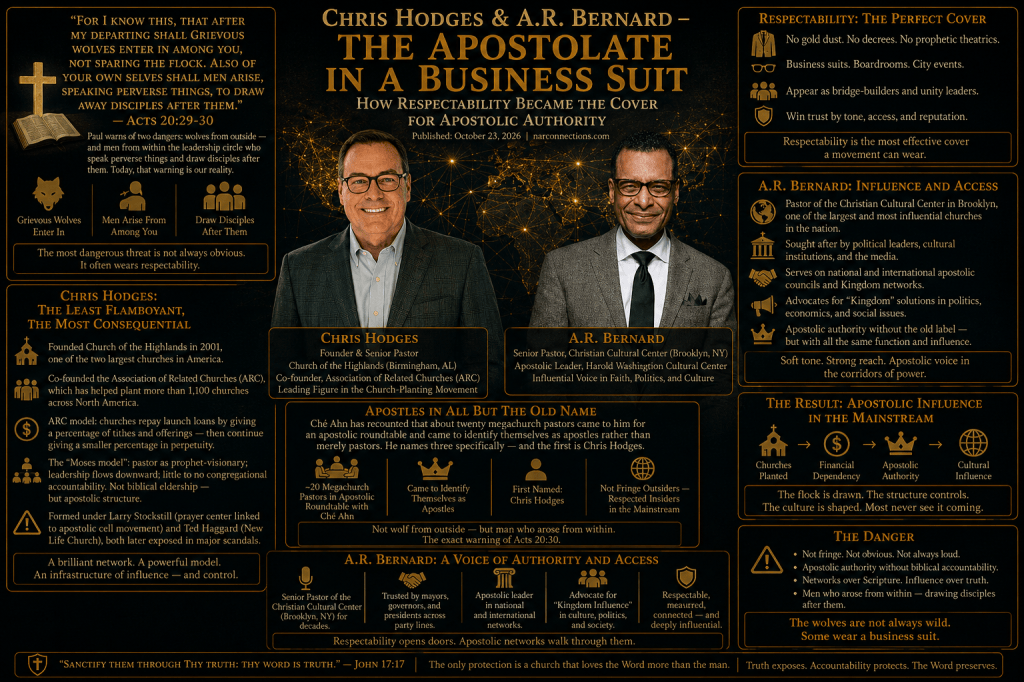
We have seen the movement in its flamboyant forms, the gold dust, the decrees, the manufactured wonder. Today we meet its most dangerous form of all, precisely because it is the least flamboyant: the apostolate in a business suit. Two men embody it. One built the most successful church-planting infrastructure in North American history while claiming no prophetic mantle in public. The other is among the most respected megachurch pastors in America, sought by mayors and presidents, whose measured tone seems to place him above the whole movement. Chris Hodges and A.R. Bernard issue no gold dust and summon no glory clouds. And that is exactly why they matter: respectability is the most effective cover a movement can wear.
“For I know this, that after my departing shall grievous wolves enter in among you, not sparing the flock. Also of your own selves shall men arise, speaking perverse things, to draw away disciples after them” (Acts 20:29-30).
This is Paul’s farewell to the elders of Ephesus, and it is the most sobering warning about church leadership in all of Scripture, because it names two dangers, not one. The first is the grievous wolves that enter in from outside, obvious predators. But the second is worse and subtler: of your own selves shall men arise, the danger from within, from the leadership circle itself, men who “speak perverse things to draw away disciples after them.” Not wild-eyed outsiders, but respected insiders, the very shepherds the flock trusted. Hold this over today’s two figures, because they are Acts 20:30 in the flesh: not wolves who broke in from the charismatic fringe, but men who arose from within the mainstream, adopted the movement’s authority under softer names, and drew disciples after them, a flock that mostly never knew it had been drawn anywhere at all.
Chris Hodges: The Least Flamboyant, the Most Consequential
When the history of how the movement moved from the charismatic fringe into the institutional mainstream is finally written, Chris Hodges will stand near the center of it, not because he is the most flamboyant figure, but because he is the least. He issues no territorial decrees, summons no gold dust, claims no prophetic mantle in public. He built something far more consequential: the most successful church-planting infrastructure in North American history, so culturally attractive and so relationally connected that it has planted more than eleven hundred churches while remaining, to most of its participants, simply a network of “life-giving congregations” with no particular theological agenda. That gap between appearance and reality is the whole point.
His formation places him squarely inside the charismatic-apostolic world. He began under Larry Stockstill at a Baton Rouge prayer center that launched a Colombian apostle’s cell movement into America, one more thread of the worldwide web, then served for years under Ted Haggard at New Life Church, until Haggard’s ministry collapsed in 2006 in a scandal that also exposed the failure of the apostolic oversight structure around him. The two men who most shaped Hodges’s pastoral formation both presided over documented governance failures around serious sin within their apostolic networks. That pattern would follow him.
The Model, and the Contracts
In 2001 Hodges founded Church of the Highlands in Birmingham, which grew into one of the two largest churches in the United States, and co-founded the Association of Related Churches. The ARC presents itself as a generous, relationship-driven planting network built on “launching large”, opening a new church with a big capital investment, a professional worship team, and polished marketing, so it begins with a crowd rather than a handful. Beneath the generosity, however, lies a financial architecture. According to contracts obtained by investigative reporting, churches planted through the ARC repay their launch loan by giving a percentage of tithes and offerings, and then continue giving a smaller percentage in perpetuity thereafter. Leadership has publicly called the ongoing payments voluntary; former ARC pastors and the contracts themselves indicate otherwise.
The model creates lasting financial dependency between the ARC and the churches it plants, giving the network both a stake in those churches’ survival and relational leverage over their pastors. And layered atop the finances is what former insiders call the “Moses model” of ministry: the pastor revered as the prophet who receives the church’s vision directly from God, which flows downward through staff without meaningful congregational accountability. It is incompatible with the New Testament’s plural, mutually accountable eldership, and entirely consistent with the apostolic framework in which the apostle receives revelation and the people receive his direction. The business suit is real; so is the apostolic structure inside it.
Apostles in All but the Old Name
The single most important documented fact in the Hodges blog comes from Ché Ahn’s own mouth, the operational heir we met on Day 8. Ahn has recounted that roughly twenty megachurch pastors came to him for an apostolic roundtable and, through that engagement, came to identify themselves as apostles rather than merely pastors. He names three specifically, and the first name is Chris Hodges. And the formal structure is visible in Church of the Highlands’ own governance: its overseers serve as “Apostolic Elders”, a title drawn not from Baptist or Reformed or even classical Pentecostal order, but from the New Apostolic framework, applied to the governance of a church with tens of thousands of weekly attenders.
The significance cannot be overstated. The movement’s apostolic governance is no longer confined to networks that fly its flag. It has been personally adopted, in their own words, by the leadership of one of America’s largest churches. This is the denominational blur completed at the highest level of the mainstream, the apostolate installed, under a softer name, in a congregation most of whose members have never heard the term. It is Acts 20:30 precisely: men arising from within, drawing disciples after them, while the disciples remain unaware they have been drawn.
The Ten-Thousand-Dollar Receipt
The closed loop this blog series and my book has traced from the beginning is captured, in Hodges’s case, in a single transaction. In 2019 Hodges was appointed to help conduct a nominally independent review of misconduct allegations against Brian Houston, and during that same period Houston’s organization sent Hodges a payment of ten thousand dollars, recorded under an obscuring label and later raised in the Australian Parliament. A reviewer receiving money from the subject of his review is not conducting an independent review; he is participating in the very economy of mutual protection that lets the movement’s leaders escape accountability. It is the same closed loop documented throughout my blog series and this book, apostles covering apostles, celebrities investigating celebrities, now with a receipt.
And the scandal cascade around the ARC is the predictable harvest of a design that concentrates unchecked authority in founding pastors while minimizing accountability for their sin. Robert Morris, an ARC-connected figure, a formal Apostolic Elder over Church of the Highlands, and Hodges’s own named mentor, pleaded guilty in 2025 to the child sexual abuse documented on Day 13. Other ARC-affiliated pastors have departed amid allegations of misconduct; a federal complaint has accused the network of using its institutional power to protect its financial interests. Here is the grievous-wolves half of Paul’s warning: a structure built to shield its leaders “spared not the flock,” and it was civil authorities, not the network, who acted. In February 2025 Hodges abruptly stepped down as lead pastor to become chancellor of the college he founded to reproduce the entire system at scale, his photograph removed from the church website amid an ongoing federal lawsuit and the wake of the Morris collapse. The move does not diminish his influence; it concentrates it in the institution most able to multiply it.
NAR Apostle/Prophet Jim Laffoon replaced Robert Morris as formal Apostolic Elder. Scroll down until you see “3. We are strengthened by Overseers.” and “The Overseers are five pastors of nationally respected congregations and ministries who love Church of the Highlands and are willing to provide spiritual protection to the church. They may be called in to help in accountability matters relating to the Senior Pastor if requested by the Pastors or Trustees. The Overseers serve as Apostolic Elders.” and the third name states clearly: “Pastor Jim Laffoon, Bethel World Outreach Church, Tennessee“
A.R. Bernard: When Respectability Is the Cover
Now the second figure, who wears the business suit even more convincingly. A.R. Bernard, lead pastor of the Christian Cultural Center in Brooklyn, one of the largest churches in the United States, is the opposite of the revival firebrand: polished, measured, sought by mayors and presidents, widely respected across secular and religious lines. His biography is genuinely remarkable, and his public reputation for principle is real. And that respectability is precisely why this blog matters, because respectability is the most effective cover a movement can wear, and the documented facts beneath it tell a different story than the demeanor suggests.
The foundational fact is a single phrase that does not belong to evangelical or Reformed vocabulary at all: A.R. Bernard operates under the “apostolic covering” of Dale Bronner. “Apostolic covering” is the specific language of the New Apostolic Reformation, the submission of a leader to the spiritual authority of a self-styled apostle within the movement’s hierarchical governance. And Bronner is no peripheral figure: he is a formal member of the International Coalition of Apostolic Leaders and an associate convener of its American arm, USCAL, the organizational spine we examined on Day 12. To sit under Bronner’s covering is to be structurally planted inside the movement’s governance, not merely adjacent to it. Whatever Bernard’s public reputation, his own ecclesiastical position is defined by submission to an ICAL apostle, which places one of America’s most respected megachurch pastors squarely inside the apostolic system this blog series and my book exists to trace.
The Company and the Content
Around that structural fact runs the familiar relational economy. Bernard’s documented endorsements include Carl Lentz, the fallen Hillsong New York pastor, Steven Furtick of Elevation, worship figures, and the Word of Faith broadcast networks that have carried prosperity teaching to the widest audience in the world. This is the celebrity-pastor web in its mainstream register, not the wild manifestations of the revival circuit, but the mutual endorsement of large, respectable platforms that lend one another credibility and audience, blurring the line between sober evangelicalism and the movement until the two can no longer be told apart from the outside.
And respectability of tone is not the same as fidelity of content. Bernard’s preaching has drawn documented concern on several fronts, importing extra-biblical sociological frameworks into the pulpit as interpretive lenses, in at least one instance bending a parable to fit the frame rather than reading the frame out of the text; and echoing the Seven Mountains theme of Christian influence over the institutions of culture. Any one of these, a careful listener might file as a matter of emphasis. Together, and read alongside his apostolic covering and his endorsement web, they form a consistent picture: a pulpit in which the sufficiency of Scripture has quietly yielded ground to sociology, to cultural strategy, and to the authority structure of a movement whose vocabulary he has adopted as his own.
Why These Two Belong Together
Set Hodges and Bernard side by side and you see why Paul’s warning named the danger from within as the graver one. Neither man is a grievous wolf who broke in from outside. Both arose from within the mainstream, one building the machinery that installed apostolic governance in a thousand churches under the banner of excellence, the other lending the movement the ratification of a reputation for principle. Both drew disciples after them: congregations, church plants, and admirers who trusted the business suit and never suspected the structure inside it. This is the completion of the mainstream bridge that began on Day 8 with Ché Ahn, the point at which the apostolate stops flying its own flag and starts wearing everyone else’s.
And it clarifies, one more time, why a denominational label can no longer protect you. The most respectable pulpit in the city may be covered by an ICAL apostle; the most admired church-planting network in the nation may run on apostolic governance and perpetual contracts. Paul’s charge to the Ephesian elders is therefore the charge to us: take heed, watch, and remember that he warned them, night and day, with tears. The danger that matters most rarely looks dangerous. It looks respected, measured, and successful, and it arises from exactly the place we were least watching: from among our own. The only safeguard that sees through the business suit is the one this whole blog series and my book keeps returning to, the sufficient Word of God, applied without deference to the reputation of the man in front of us.
Tomorrow, the bridge figure who is not an apostle at all, and whose sincerity is the very thing that makes her blog so instructive: Beth Moore.
“Also of your own selves shall men arise, speaking perverse things, to draw away disciples after them.” — Acts 20:30 KJV
📖 This post is adapted from NAR Connections: Connecting The Dots. If it helped you, the full book is available on Amazon — or you can support this ministry directly.
thefinalconvergence.com | Follow on Instagram, Facebook, X, and YouTube
If you like to be updated on new blogs, sign up to our newsletter!


Leave a Reply