
Published: September 5, 2026 | thefinalconvergence.com
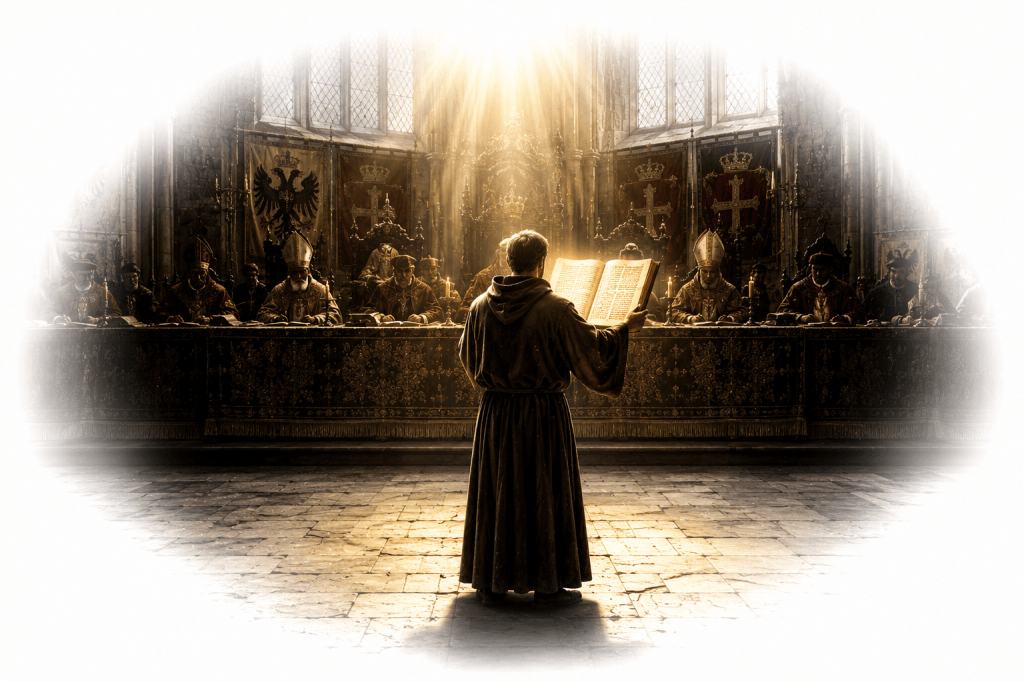
For eighteen days the series has established what the canon is, recognized, closed, complete at sixty-six books, defended against every counterfeit. Now comes the practical payoff, the doctrine that turns all of it into something you can live on: if the canon is closed, then the canon is sufficient. God has said everything He intends to say through inspired Scripture, which means Scripture is enough for everything the church needs until Christ returns.
This is the doctrine the Reformation was actually about. And it is under sustained attack from more directions than most believers realize.
“All scripture is given by inspiration of God, and is profitable for doctrine, for reproof, for correction, for instruction in righteousness: That the man of God may be perfect, throughly furnished unto all good works” (2 Timothy 3:16-17).
Perfect, the Greek artios, meaning complete, adequate, fully equipped. Throughly furnished, exērtismenos, fitted out for every task. Paul’s claim is comprehensive: the God-breathed Scriptures are sufficient to equip the man of God for every good work. Not most good works. Not the good works of the first century. Every good work. That is sufficiency, and it is the practical implication of everything the series has built.
The Battle Cry That Changed the World
On October 31, 1517, Martin Luther nailed his Ninety-Five Theses to the door of the Castle Church in Wittenberg, and the Reformation began. But the Reformation was not primarily about indulgences, or even the papacy. It was about Scripture. Every specific controversy Luther raised; indulgences, purgatory, the authority of the pope, justification, the sacraments, was ultimately a question about the relationship between the Word of God and the traditions of the church.
Luther’s answer, crystallized at the Diet of Worms in 1521 when he was ordered to recant, was Sola Scriptura, Scripture alone. Unless he was convinced by the testimony of the Scriptures or by clear reason, he said, he could not recant, for he did not trust popes or councils alone, since they had often erred and contradicted themselves; his conscience was captive to the Word of God.
That was not a rejection of all tradition, reason, or church authority. It was a declaration of the supremacy and sufficiency of Scripture as the final court of appeal for all questions of faith and practice. The church can speak. Tradition can inform. Reason can assist. But none of these can bind the conscience the way the written Word can, because none of them carries the same divine authority.
What Sufficiency Means
Sufficiency is the practical implication of the closed canon. If God has said everything He intends to say through inspired Scripture, then Scripture must be sufficient for everything the church needs to know and do until Christ returns.
This means the Bible does not need to be supplemented, not by the Talmud, the Qur’an, or the Book of Mormon; not by papal encyclicals; not by the prophetic declarations of NAR apostles; not by the latest book from a celebrity pastor. It is already everything the church needs.
This does not mean no other books are valuable. The great theologians of the church; Luther, Calvin, Owen, Whitefield, Spurgeon, produced writings of profound value. They illuminate Scripture, apply it to specific contexts, and help the church think more clearly about biblical truth. But they are servants of Scripture, not its equals. The moment a book by a human author is treated as having authority over or alongside Scripture, the moment it is placed on the same shelf and given the same deference, the doctrine of sufficiency has been abandoned.
The Assault from Three Directions
The sufficiency of Scripture is under sustained attack in our generation, and the attacks come from multiple directions at once.
From the academic left comes higher criticism, which has spent two centuries arguing that the biblical text is a patchwork of contradictory human documents, the Documentary Hypothesis for the Pentateuch, the multiple-author theory for Isaiah, the claim that Daniel was written after the events it predicts. Each is designed to undermine confidence in Scripture’s reliability and inspiration. If the Bible is merely a human document riddled with error, it obviously cannot be sufficient. But the textual, archaeological, and historical evidence has consistently vindicated the biblical account, and the critical theories that claimed to demolish it have, decade by decade, been revised, abandoned, or refuted.
From the charismatic and prophetic movements the attack comes from the opposite direction. Here the Bible is not denied, it is supplemented. The claim is that God continues to speak with prophetic authority through anointed individuals whose words must be received with the same submission as the written Word. The NAR, the charismatic renewal, IHOP and its affiliates, and the explosion of prophetic culture have given this enormous momentum. The practical result is that the Bible becomes background music, while the prophetic word becomes the main event.
From progressive Christianity comes the claim that the Spirit is doing a new thing in each generation that requires the church to move beyond what the text says, to embrace practices the plain reading of Scripture prohibits but cultural sensibility demands. The claim is always the same: the Spirit is doing something new, and the old text must be reinterpreted in the light of it. But a Spirit who contradicts the Word He inspired is not the Holy Spirit of Scripture.
The Oldest Assault — and the First Domino
There is a fourth assault, older than either the charismatic or progressive versions, and in many ways more consequential because it struck closer to the foundation. It is the cosmological assault: the claim that while Scripture is authoritative in matters of salvation and ethics, it does not speak with reliable authority about the physical world God made.
This distinction was not always present in the church. The Reformers took the biblical description of creation seriously. Luther and Calvin both affirmed the plain reading of Genesis 1 as a literal account of six actual days, not a poetic framework, not a literary accommodation to ancient culture, but a straightforward historical account of what God actually did. They affirmed a young earth, and a creation that happened exactly as Moses described it, in the order and timeframe Moses described.
But beginning in the early modern period, as a new scientific consensus gained cultural dominance, a quiet exception was introduced into the church’s hermeneutics: Scripture can be accommodated to scientific consensus on questions about the physical world. The creation days of Genesis 1 were stretched to accommodate billions of years. The global Flood was reduced to a local incident or legend. The historical Adam was quietly replaced by a symbolic figure at the head of an evolutionary process. The text had not changed. The exegetical case had not weakened. What had changed was the cultural cost of holding to it.
The closed canon was not formally reopened, but the principle that Scripture can be overridden by scientific consensus in its statements about the physical world was established. And once that principle was in place, the same move became available progressively: for chronology, for biology, for human origins, for the Fall, and ultimately for the necessity of the Atonement itself. If death existed before Adam, the entire structure of Romans 5 collapses. The cosmological capitulation was the first domino, and the chain it set falling runs directly through the theological landscape of the modern church. (What the full recovery of Sola Scriptura looks like when applied to Genesis, creation, the genealogies, the Flood, the age of the earth, is the subject of a future volume in this series, In the Beginning.) Sufficiency is not a partial principle. It is the supreme authority of the Word in everything it addresses, and it addresses the world God made.
Sola Scriptura Is Not Solo Scriptura
One distinction must be drawn to protect the doctrine from a common misapplication. Sola Scriptura, Scripture alone, is not solo scriptura, Scripture in isolation, stripped of all community, history, and theological reflection.
Solo scriptura is the position of the person who says, it’s just me and my Bible; I don’t need creeds, confessions, commentaries, or teachers. As the previous volume in this series, Biblicism, documents in detail, this is actually the straw man that critics of Sola Scriptura routinely use to discredit the genuine article. Solo scriptura argues for isolated private interpretation answerable to no one. Sola Scriptura, properly understood, argues that Scripture stands supreme over all human authority while fully welcoming the insights of faithful teachers, church history, and theological community. The distinction is one of final authority, not rejection of community. Sola Scriptura says the Bible is supreme over tradition. Solo scriptura says my interpretation is answerable to no one. Confusing them is a dishonest tactic designed to make faithfulness to the Word look like arrogance.
The Reformers understood this. Calvin did not write the Institutes by discovering Scripture’s meaning in isolation, he drew on the church fathers, on Luther and Zwingli and Bucer, on the exegetical tradition of centuries. The great confessions; Augsburg, Heidelberg, Westminster, Belgic, represent the church’s finest attempts to summarize what Scripture teaches, immensely valuable precisely because they were crafted by communities immersed in both the text and the interpretive tradition. They are servants of Scripture, not its replacements. The right response to a bad private reading is not to place the confession above Scripture, but to bring one’s reading into honest conversation with the community, while holding fast that the text, not the community, has the final word.
The Sufficiency That Sustains
The ultimate argument for sufficiency is not philosophical. It is historical and personal. For two thousand years, the Bible has sustained the church through persecution, heresy, cultural upheaval, and every form of spiritual assault. It has converted pagans and philosophers, comforted the dying, strengthened the martyred, built civilizations and survived their collapse. Translated into more than seven hundred languages, it has produced in every one of them the same fruit: conviction of sin, repentance, faith, transformation, and the joy of knowing the living God.
No supplemental revelation has done this. The Book of Mormon has not produced communities marked by the fruit of the Spirit of Galatians 5. The NAR’s prophetic culture has not produced churches marked by holiness and doctrinal depth. The progressives who replaced biblical authority with therapeutic affirmation have not produced genuine revival. The Bible alone has produced the martyrs of the early church, the theologians of the Reformation, the great missionary movements, the revivals, the underground churches of persecuted nations, and the individual believers who have walked faithfully with God in every generation.
The Word is sufficient. It always has been. It always will be. And a Word that is sufficient is a Word worth hiding in your heart.
Tomorrow, the volume that carried this sufficient canon into the English-speaking world: the King James Bible.
“That the man of God may be perfect, throughly furnished unto all good works.” — 2 Timothy 3:17 KJV
📖 This post is adapted from Canon and Covenant: How God Preserved His Word Through History. If it helped you, the full book is available on Amazon — or you can support this ministry directly.
thefinalconvergence.com | Follow on Instagram, Facebook, X, and YouTube
If you like to be updated on new blogs, sign up to our newsletter!


Leave a Reply